No, the Moon Is Not Motionless: The Fact-Check That Makes the Moon Move
Go outside on any clear night, look up, and the Moon greets you with a face you have known all your life. The dark patches that suggest a face — the “man in the Moon” — are exactly where they were when you were a child, where they were when your grandparents were children, and where they have been for the whole of human history. The Moon’s features never turn away. The same craters, the same seas of frozen lava, the same bright highlands: the Moon presents them to Earth night after night, decade after decade, millennium after millennium.
And that unchanging face has smuggled a false idea into countless classrooms, pub quizzes, and internet debates: the claim that the Moon does not rotate at all. The reasoning sounds watertight. A spinning thing shows its different sides. We always see the same side of the Moon. Therefore, the Moon cannot be spinning. Case closed.
It is a beautiful piece of logic. It is also completely wrong. The Moon does rotate — it turns once on its axis every 27.3 days, which is exactly as long as it takes to orbit Earth. The reason we always see the same face is not that the Moon stands still, but that its spin and its orbit are locked in perfect step. Astronomers call it synchronous rotation, and it is one of the most elegant gravitational dances in the solar system. ProofNews traced the claim to its roots, consulted the physics, and found the “motionless Moon” wanting.
The Claim, As It Circulates
The motionless-Moon claim wears several disguises. In its bluntest form, it says the Moon has no rotation whatsoever — it simply circles Earth like a ball on a string, presenting the same face the way a tied object always faces inward. A softer version says the Moon is “fixed” or “motionless” in space, hanging above Earth while going around it. A third version arrives through the back door of a true term: people learn that the Moon is “tidally locked” and read that as meaning it never turns.
The confusion is so common that it has made its way into school physics question-and-answer pages, where students are asked to judge the statement “The moon does not rotate because it is tidally locked with the Earth” as true or false. The fact that educators feel the need to set the question tells you something important: this is not a fringe belief held by flat-Earthers in a corner of the internet. It is a misunderstanding that sits comfortably inside mainstream classrooms, repeated by people who have done their homework badly. The words “tidal locking” get invoked as the explanation, and the explanation gets mangled into “so it doesn’t spin.”
The claim’s durability is understandable. Human intuition about spinning comes from tops, wheels, and figure skaters — things whose rotation we perceive because the scenery changes. If you watch a rotating wheel, you see each spoke sweep past. If you watch the Moon for a month, you see the same features in the same places. Our eyes report stillness. But our eyes are in the wrong frame of reference, and the universe is under no obligation to look the way our intuition expects.
The Core Fact: Yes, the Moon Rotates
Let us settle the headline fact first, because everything else is commentary on it. The Moon rotates on its axis once every 27.32166 days, and it completes one orbit around Earth in that same period. That number — roughly 27.3 days — is the Moon’s sidereal period, its motion measured against the distant stars, which is, as one physics educator puts it, about the truest basis there is for establishing rotation. Against the backdrop of the fixed stars, the Moon is turning. Not fast, not dramatically, but genuinely, continuously turning.
This is the fact that explodes the myth on contact. A body that does not rotate does not turn relative to the stars at all. The Moon does. Once every 27.3 days, every part of its surface points, in turn, toward every direction in space. The claim “the Moon does not rotate” is therefore not a rough approximation or a harmless simplification. It is false in the strict, literal sense: rotation is defined as turning on an axis, and the Moon does exactly that.
Why, then, does the turning hide from us? Because we are not watching from the stars. We are watching from Earth, riding alongside the Moon as it orbits us, and from that moving viewpoint, two equal motions cancel each other out. The Moon’s spin and its orbit march in lockstep, one rotation per one revolution, and the result is that the same hemisphere keeps facing us. Astronomer Alan P. Boss of the Carnegie Institution of Washington summed it up for Scientific American: “the moon rotates exactly once every time it circles the Earth.” The always-familiar face is not evidence of stillness. It is evidence of synchrony.
Synchronous Rotation, Explained
The term of art is synchronous rotation, and the physical process that produced it is tidal locking. Both terms deserve a plain-English unpacking, because the mechanism is where the real understanding lives.
Start with tides. The Moon’s gravity pulls on Earth, stretching the planet’s oceans into bulges — the high tides. The mirror image of that process is what Earth does to the Moon. Because Earth is far more massive, its gravitational grip on the Moon is far stronger than the Moon’s grip on Earth, and Earth’s gravity stretched the young Moon into a slightly elongated shape, a bit like a football, with its long axis pointing toward Earth. When the Moon was young, it spun faster than it orbits today, and that rotation carried the elongated bulge out of alignment, so the bulge pointed slightly away from the Earth-Moon line. Earth’s gravity tugged on that misaligned bulge, trying to drag it back into line, and that tugging acted as a brake on the Moon’s spin.
This is the tidal brake. It is not fast — it is the work of millions and then billions of years — but it is relentless. Over deep time, Earth’s gravity slowed the Moon’s rotation down, down, down, until the spin rate matched the orbital rate. At that point, the bulge sat permanently on the Earth-Moon line, the braking torque fell to zero, and the system settled into a stable, lowest-energy state: one rotation per orbit, forever. The Moon had become tidally locked. This is the same mechanism that has locked the great majority of the solar system’s other moons — Jupiter’s Io, Europa, Ganymede, and Callisto among them — and in the Pluto system the process has gone one step further: Pluto and its moon Charon are locked to each other, each forever showing the same face to the other.
It is worth pausing to appreciate what this means. The Moon is not locked because the universe froze it in place like a museum exhibit. It is locked because it was once spinning freely and gravity, over billions of years, ground that freedom down into perfect synchrony. Tidal locking is a process with a direction, a history, and a final state. “Does not rotate” misses all of that. It mistakes the end of a long braking process for the absence of motion.
The Campfire Test: How to See the Spin for Yourself
There is a classic demonstration of synchronous rotation, and you can perform it tonight with a friend and no equipment beyond your two bodies. Ask your friend to stand in one spot — they are Earth. You are the Moon. Now walk in a slow circle around them, and as you walk, turn your body at exactly the rate needed to keep your face pointed at them the whole time. Your friend sees only your front, no matter where you stand in the circle.
Now ask yourself: did you rotate? You certainly felt it — your shoulders swept through a full turn as you circled. Someone standing far away, watching against the fixed trees and lampposts, would have seen you pivot through 360 degrees. You made one full rotation in exactly the time it took to complete one orbit. That is precisely what the Moon does.
Now do the experiment wrong on purpose. Walk around your friend again, but this time keep your body rigid — shoulders always pointing at the same distant lamppost, never turning. As you orbit, your friend will see, in sequence, your front, your side, your back, and your other side. This is what a truly non-rotating Moon would look like from Earth: over one month, the whole surface — near side, far side, everything — would swing into view. The fact that it does not is proof that the Moon is rotating. This is the point that makes the myth self-defeating: if the Moon genuinely did not spin, we would not see the same face all month. We would see every face, one after another.
A sharper version of the test uses the stars. Rotation, properly defined, is measured against the distant background, not against the planet you are orbiting. Track a fixed crater — say, the bright-rayed crater Tycho in the southern highlands — against the star field behind the Moon over a month, and you will watch it slowly swing through a complete circuit. The Moon’s face is fixed relative to Earth, but it is turning relative to everything else. The claim that it “does not rotate” requires you to pretend the stars do not exist.
How the Lock Happened: A Four-Billion-Year Brake
The story of how the Moon got locked is a story of deep time, and it explains one of the most counterintuitive details of the whole business: that the Moon’s near side and far side look so different.
When the Moon first formed — the prevailing giant-impact hypothesis holds that a Mars-sized body struck the early Earth and the debris coalesced into our satellite — it was much closer to Earth than it is now, and it spun much faster. The tides Earth raised on that young Moon were correspondingly enormous. As the Moon spun, its tidal bulge was dragged around ahead of the Earth-Moon line, and Earth’s gravity grabbed that bulge and braked the spin, steadily and patiently. As the spin slowed toward synchrony, the bulge settled into alignment with Earth, where it sits to this day: the Moon is still slightly elongated, with its long axis perpetually pointing at us.
Scientific American’s explainer notes that the Moon’s synchronous state “is thought to have arisen billions of years ago, when the moon was much closer to the Earth, and so tidal forces were much stronger than at present.” Earth’s gravity then maintained the lock even as the Moon drifted outward to its present distance — a drift that continues today, powered by the same gravitational exchange running in reverse. The tides the Moon raises on Earth are slowly bleeding Earth’s rotational energy away, lengthening our days and pushing the Moon a few centimeters farther from us each year. In the immensely distant future, physics educators note, the Earth and Moon will reach the same kind of mutual synchrony that Pluto and Charon have already achieved: Earth’s day will eventually stretch to match the lunar month, and the two bodies will face each other forever. That will not happen for hundreds of billions of years — long after the Sun has died — but the direction of travel is set. The Moon’s lock is not a static accident. It is one frame in a very long movie.
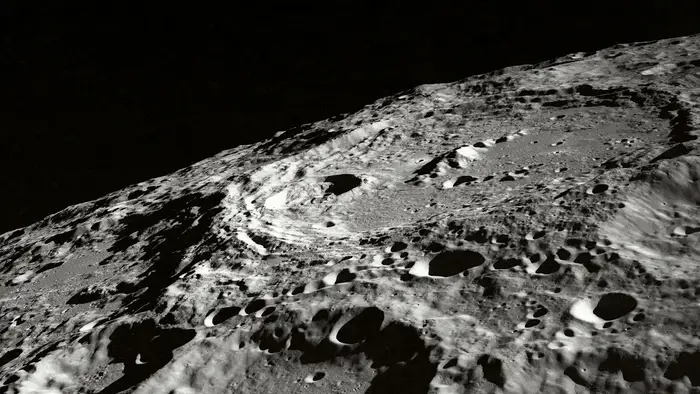
The visual difference between the near and far sides is a separate story, but it feeds the same myth. The familiar near side is dominated by the dark maria — the “seas” of solidified lava that ancient skywatchers mistook for water. The far side, photographed for the first time by the Soviet spacecraft Luna 3 on October 7, 1959, is far more heavily cratered and almost entirely lacks those dark plains. The reason is thought to involve the Moon’s crustal structure: the near-side crust is thinner, so ancient impacts could crack through it and let magma flood the surface, while the far side’s thicker crust kept its battered, bright highlands. None of this has anything to do with rotation. But it does have something to do with the companion myth — that the far side is the “dark side” — which deserves its own demolition below.
Libration: The Wobble That Proves the Point
Here is a fact that the “motionless Moon” claim cannot survive contact with: over time, we can see about 59 percent of the Moon’s surface from Earth — nine percentage points more than the 50 percent a perfectly rigid lock would allow. If the Moon truly did not rotate, and simply presented one fixed hemisphere, the visible fraction would be exactly half, no more, no less. The extra nine percent is a visible, photographable signature of the real mechanics, and it is called libration.
Libration is a slow wobble in the Moon’s apparent face, and it has three main causes, each of them grounded in the Moon’s real, imperfect motion. First, the Moon’s orbit is slightly elliptical, not a perfect circle. The Moon spins at a perfectly constant rate, but its orbital speed varies: it moves faster when closer to Earth and slower when farther away. That mismatch lets the spin run a little ahead of the orbit at some points and lag behind at others, so we get to peek a few degrees — up to about 7.9 degrees — around the eastern and western limbs. Second, the Moon’s rotation axis is tilted about 6.7 degrees relative to its orbit, so over the course of a month we alternately peer over its north pole and under its south pole. Third, our own vantage point matters: an observer’s position on Earth’s surface shifts the view by a small amount over the course of a night.
The net effect, confirmed by generations of lunar photography, is that the Moon’s face rocks gently north-south and east-west on a monthly cycle, and careful observers can watch familiar limb features — the isolated dark sea Mare Crisium, for example — slide toward and away from the edge. This wobble is the opposite of motionlessness. It is the visible remainder of the Moon’s real orbital mechanics, and it would be impossible if the Moon were simply nailed in place. As one astronomy explainer puts it, the Moon’s spin and orbit “aren’t perfectly matched” — and that tiny imperfection is precisely what lets us see around the edges.
Far Side, Dark Side: The Myth’s Evil Twin
The motionless-Moon myth travels with a companion claim that is just as wrong and just as persistent: that the far side of the Moon is the “dark side,” a hemisphere of perpetual night. The two myths feed each other — if the Moon never turns, the thinking goes, then the unseen side must be forever shadowed. In reality, the far side gets exactly as much sunlight as the near side.
The distinction is simple but crucial. The far side is the hemisphere that faces away from Earth — a fixed piece of geography, defined by the tidal lock. The dark side is whichever half of the Moon is not currently lit by the Sun — a condition that sweeps steadily around the entire Moon as it runs through its monthly phases. At new moon, when the near side is dark, it is the far side that is bathed in full sunlight. Over the course of a lunar month, every part of the Moon — near side, far side, poles, equator — experiences roughly 29.5 Earth days of continuous daylight followed by the same span of night. The far side has sunrises and sunsets exactly like the near side. It is simply hidden from Earth’s view, not hidden from the Sun.
This is why lunar scientists wince at the phrase “dark side of the Moon.” The far side was not even mysterious for very long: Luna 3 photographed it in 1959, and modern orbiters have mapped it in exquisite detail. It is rugged, cratered, and ancient — but it is not dark. Conflating “far” with “dark” is the same category of error as conflating “synchronous” with “stationary”: a true technical term, tidal locking, gets flattened into a false picture.
Why the Myth Survives
If the physics is this settled — and it is; synchronous rotation is textbook material, established for over a century — why does the motionless-Moon claim keep resurfacing? ProofNews sees several reinforcing reasons.
First, the claim borrows authority from a genuine scientific term. “Tidally locked” sounds like it could mean “not moving.” The word “locked” does a lot of misleading work in English: we lock doors to keep them still. But in celestial mechanics, a lock is a synchronization, not a paralysis. A tidally locked moon is not a frozen moon; it is a moon whose two motions have been tuned to the same tempo. The phrase invites exactly the misunderstanding it then appears to confirm.
Second, the evidence of our senses is genuinely ambiguous. “Rotation” is an abstract concept — motion relative to an inertial frame — while what we see is a relationship: the Moon’s face relative to our eyes. The myth mistakes the relationship for the motion. This is the same class of illusion that once convinced humanity the Sun orbited Earth: from the ground, the geometry of the observation overwhelms the geometry of the thing. It takes a deliberate act of imagination — the campfire test, the star-field tracking — to put the observer back in the right frame.
Third, the myth is half-protected by pedantry in reverse. Some defenders of the claim will retreat to “well, it doesn’t rotate relative to us” — which is true, and which is exactly what synchronous rotation means, and which is precisely not what “the Moon does not rotate” says. Rotation does not come in flavors depending on who is watching. The Moon either turns on its axis or it does not, and measured against the only frame that counts — the distant stars — it turns, once every 27.3 days. Qualifying the claim into truth does not save the original claim; it abandons it.
And fourth, there is a quieter contributor: the internet’s appetite for counterintuitive “did you know” content. “The Moon doesn’t actually rotate!” is a perfect viral factoid — surprising, easy to state, seemingly profound, and just technical enough to sound like secret knowledge. It spreads precisely because it feels like the kind of thing the experts are hiding. The experts are not hiding it, because it is not true. The genuinely interesting secret — that the Moon’s spin and orbit are locked in a billion-year gravitational embrace — is harder to compress into a meme, and so the meme wins the retweets while the physics waits in the textbook.
The Verdict
The claim that the Moon does not rotate is False.
The Moon rotates on its axis once every 27.3 days — the same period as its orbit around Earth, a state called synchronous rotation produced by tidal locking over billions of years. The unchanging lunar face we see is the result of that precise synchronization, not of stillness. Indeed, if the Moon truly did not rotate, we would see its entire surface over the course of a month rather than the same familiar face — the myth contradicts the very observation it claims to explain. Lunar libration lets us glimpse 59 percent of the surface over time, a wobble that a motionless Moon could never produce, and the far side receives just as much sunlight as the near side. The Moon turns. It has always turned. It is just polite enough to keep facing us while it does.
The next time someone tells you the Moon does not spin, invite them to try the campfire test. Have them walk a slow circle around you while keeping their face toward you the whole time, and then ask them whether they turned. They will feel the answer in their own shoulders before their brain catches up: one full rotation, one full orbit, perfectly in step. That is not the signature of a motionless world. It is the signature of one of the most beautiful resonances in the night sky — a world that dances around us while never once turning its back.