You Don't Have Just Five Senses — the Ancient Lesson Modern Neuroscience Outgrew
Close your eyes and touch the tip of your nose with your index finger. You can do it, almost certainly, on the first try, without peeking, without groping around your face like a stranger looking for a light switch. Now stand up, still with your eyes closed, and stay standing. You do not fall over. You do not need to look at your feet to know where they are, or at your arms to know whether they are hanging at your sides or folded across your chest.
None of that information came through your five famous senses. Your eyes were closed, so sight is out. You heard nothing relevant, smelled nothing relevant, tasted nothing. And touch, strictly speaking, tells you about contact with your skin — the pressure of the floor under your feet, the fabric of your shirt against your arm — not about the angle of your elbow or the position of a finger you have not yet touched to anything. Yet you knew. Some channel of information, working quietly below conscious thought, told your brain exactly where your body was in space.
That channel has a name, and it is not one of the five you learned in school. It is called proprioception, and it is only the beginning. The claim that human beings have just five senses — sight, hearing, smell, taste, and touch — is one of the most successful simplifications in the history of education. It is also false. Modern neuroscience counts many more senses than five, and the exact total depends on how you count, but no serious count stops at five. The five-sense model was a philosopher’s sketch, drawn more than two thousand years ago, before anyone knew what a nerve was. It survived because it is tidy, memorable, and easy to teach to children. It did not survive because it is true.
The claim in every classroom
The claim is so familiar that it barely registers as a claim at all. It arrives in primary school, usually with a poster: an eye for sight, an ear for hearing, a nose for smell, a tongue for taste, a hand for touch. It arrives in songs, in worksheets, in museum displays, in the opening chapters of textbooks. Most adults carry it unexamined for the rest of their lives, the way they carry the idea that there are three states of matter or that the Great Wall of China is visible from space — other tidy classroom facts that turn out, on inspection, to be wrong or incomplete.
Notice what the claim actually says. It is not merely that humans have five senses among others. It is that five is the number: the complete inventory, the full set, the whole story of how a human being gathers information about the world and about itself. If that were true, then everything you know about your body and your surroundings would have to arrive through those five channels. The finger-to-nose test you just performed suggests otherwise, and it is only the easiest demonstration. The evidence gets much stronger, and much stranger, from here.
Where five came from
The five-sense model comes from Aristotle, the Greek philosopher who set it out in his treatise De Anima, written around 350 BCE. Aristotle identified five perceptual channels — sight, hearing, smell, taste, and touch — through philosophical reflection, not through biological investigation. He had no microscope, no knowledge of neurons, no way to trace a signal from a receptor in a muscle to the brain. He was reasoning about experience from the inside, and he produced a list that felt complete because it matched the obvious organs: eyes, ears, nose, tongue, skin.
That list then did what authoritative lists do. It passed into medieval scholarship, was translated into Latin, was embedded in European university teaching, and was handed down, largely unchanged, into modern schooling. A framework that began as one philosopher’s introspection hardened into common sense. Even Aristotle himself, according to modern scholars of his work, seems to have suspected that touch was not a single unified sense at all — a hint that the tidiness of the list was questionable from the start.
The deeper problem is that the five-sense model sorts senses by organ, and the body does not work that way. Your skin alone hosts several different kinds of receptor, reporting pressure, vibration, texture, temperature, and pain through different machinery. Your tongue does not work alone when you eat: what you call taste is mostly smell, plus touch, plus temperature, assembled by the brain into flavor. And several of your most important senses have no obvious outward-facing organ at all, because they monitor the inside of your body rather than the world outside it. Sorting by organ was a reasonable first guess in 350 BCE. It is a poor map of a nervous system.
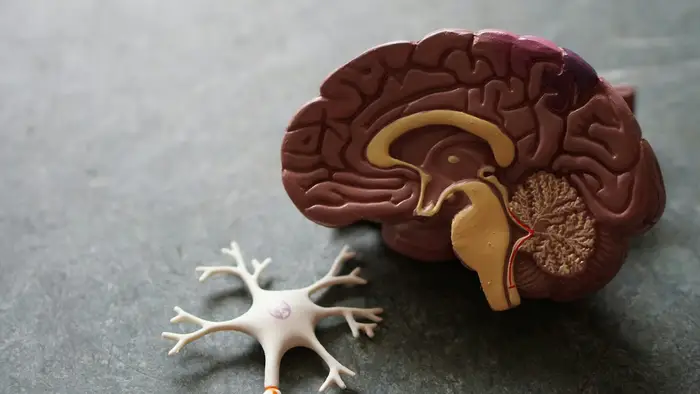
An anatomical model of the human brain: the organ that assembles many separate sensory channels into one seamless experience of the world.
The sense you use every second: proprioception
Start with the sense you just used. Proprioception is your body’s continuous, real-time awareness of where its parts are and how they are moving, without any need to look. Specialized sensors in your muscles, tendons, and joints constantly report to your brain: this muscle is stretched this far, that joint is bent at this angle, this much force is being exerted. Muscle spindles detect changes in muscle length and the speed of stretching; Golgi tendon organs report tension; receptors in the joint capsules report flexion and extension. Together they maintain an internal map of the body — a body schema — that updates dozens of times a second, entirely beneath conscious attention.
The term itself is modern. In 1906, the English physiologist Charles Scott Sherrington introduced the words proprio-ception, intero-ception, and extero-ception to describe receptors whose stimuli come from the body’s own tissues, from the internal organs, and from the outside world respectively. Sherrington’s point was that muscles do not merely receive orders from the brain; they also send information back. A muscle is a sense organ as well as a motor. That idea, radical in its day, is now textbook physiology: the sense of limb position and movement is generated by signals arising in the periphery, in the body’s own tissues, not merely by the brain keeping track of the orders it sent out.
You rely on proprioception for almost everything you do without thinking. Walking without watching your feet. Typing without watching your fingers. Reaching for a glass in the dark and actually finding it. Scratching an itch on your back without a mirror. Catching a ball, or at least getting a hand somewhere near it. Each of these depends on the brain knowing, moment by moment, where the limbs are. Vision can substitute for proprioception when it fails — as the next section shows, at a terrible cost in effort — but vision is a stand-in, not the original system. Proprioception is a sense in its own right, with its own receptors, its own pathways, and its own job.
The man who lost his body
The strongest proof that proprioception is a real, separate sense is what happens when it is taken away. In 1971, a 19-year-old man named Ian Waterman suffered a sudden illness — an undiagnosed fever believed to have triggered an autoimmune reaction — that destroyed the large sensory nerve fibers carrying touch and proprioception from his neck down. His muscles were untouched. His motor nerves were untouched. There was no paralysis in the ordinary sense: he could still command his muscles to contract. What he had lost was the feedback that tells the brain what the body is doing.
The result was devastating in a way that is hard to imagine until you try to picture it. Waterman woke up unable to sit up, walk, feed himself, or manipulate objects — not because his body would not move, but because he had no idea where it was or what it was doing unless he looked at it. His body had, in the phrase that became the title of the book about him, disappeared. He could will his hand to move, but without vision he would have no idea whether it had moved, or where it had gone. Movement without proprioception is like trying to steer a car with the windshield painted black and no instruments: the engine works, but the driver is blind.
Over years of extraordinary effort, Waterman taught himself to move again under constant visual control. He learned to walk, to stand, to use a pen, to gesture while speaking — but every movement requires watching his limbs and concentrating intensely, and if the lights go out unexpectedly, he falls down. That is not a metaphor. Without visual compensation, the loss of proprioception leaves a person effectively unable to coordinate movement at all. A sense whose absence cripples ordinary action that completely is not a minor footnote to the five famous senses. It is one of the most important senses a human being possesses, and most people have never heard its name. That alone demolishes the claim that five is the full inventory.
Balance: the sense in your inner ear
Proprioception is not the only hidden sense. Consider balance. Your vestibular system, housed in the inner ear, reports the movement and orientation of your head: acceleration, rotation, and position relative to gravity. Its semicircular canals sense rotation; working together with sight and proprioception, it keeps you upright, stabilizes your gaze when your head moves, and tells you which way is up when you close your eyes.
Balance fails the five-sense test in the same way proprioception does. It is not touch: you can feel perfectly well and still be dizzy. It is not sight: you can stand steadily in the dark. It is a dedicated system with dedicated hardware, and when it goes wrong — in an inner-ear infection, for example — the result is vertigo, nausea, and an inability to walk straight, even though all five textbook senses may be working normally. Anyone who has ever spun around until dizzy and then tried to walk a straight line has felt the vestibular system protesting. The spinning did not damage your eyes or your skin. It scrambled a sense that the five-sense poster never mentions.
Motion sickness is the same system misfiring in a different way: when the vestibular system reports one kind of motion and the eyes report another — reading in a moving car is the classic case — the brain receives conflicting testimony from two senses it normally trusts, and the stomach objects. That conflict only makes sense once you accept that balance is a sense of its own, capable of disagreeing with vision. On the five-sense model, there is nothing for vision to disagree with.
Pain and temperature are not just touch
Two more senses hide inside the word “touch.” Nociception is the sense of pain: specialized receptors called nociceptors respond to potentially damaging stimuli such as extreme heat, extreme pressure, or tissue damage, and report them as pain. Thermoception is the sense of temperature: thermoreceptors in the skin report heat and cold. Researchers treat both as sensory systems in their own right, distinct from the receptors that report light pressure, vibration, and texture.
The distinction matters, and not only to textbook writers. Pain and temperature travel through different receptors and different pathways from ordinary touch, which is why they can be affected independently: a person can lose one kind of sensation while keeping others, and the brain treats a burn as different information from a handshake. You do not need to touch a hot stove to know the air near it is hot; radiant heat reaches thermoreceptors without contact. And pain is not merely intense touch — it is an alarm system with its own logic, warning of damage rather than describing surfaces. Lumping pain, temperature, pressure, and texture together under the single label “touch” is like lumping sight and hearing together because both involve the head. It hides real biology behind a convenient word.

A glass of cold water: sensing its coldness is thermoception, a system distinct from the touch receptors that report the glass itself.
The eighth sense: interoception
Then there is the sense that watches the inside of your body. Interoception is the perception of internal bodily signals: hunger and fullness, thirst, heartbeat, breathing rate, the need to use the bathroom, the flutter of anxiety in the stomach, the ache of tired muscles. Receptors throughout the organs, skin, and muscles deliver this information through the nervous system to the brain — particularly to a region called the insular cortex — where it is integrated into an assessment of how the body is doing and what it needs.
Interoception is often called the eighth sense, counting the classic five plus vestibular, proprioceptive, and interoceptive systems — the three “hidden” senses that work inside the body rather than facing outward. The label is popular in occupational therapy and sensory-integration work, where the eight-sense framework helps explain why some children struggle with balance, body awareness, or recognizing hunger and fullness. But you do not need a clinical framework to recognize interoception in your own life. You knew you were hungry before anyone told you. You can feel your heart beating faster after climbing stairs, and you can tell the difference between that and the racing heart of nervousness — most of the time, at least, because interoceptive signals also feed into emotion. The racing heart, the shallow breathing, the jittery stomach: the brain reads those internal signals and helps construct what you experience as feeling nervous, excited, or afraid. Interoception is not just a maintenance gauge. It is part of how emotions are made.
That is a striking claim, and researchers are careful about how far to push it, but the basic point is not controversial: a system that reports the state of your internal organs, through its own receptors and pathways, is a sense by any reasonable definition. It informs you, it guides your behavior — eat, drink, rest, breathe — and it operates whether or not you attend to it. It simply never made Aristotle’s list, because Aristotle was cataloguing how we perceive the world, not how we perceive ourselves.

A stethoscope, the clinician’s tool for listening to the internal signals — heartbeat, breathing — that interoception reports from inside.
Why the count keeps growing
Once you accept proprioception, balance, pain, temperature, and interoception, the count is already at ten, and it does not stop there. This is where the honest answer gets complicated, and where a careful fact-check must resist replacing one tidy number with another. How many senses humans have depends on how you define a sense, and researchers disagree about the definition.
The conservative count adds the hidden senses to the classic five and stops at eight or nine. A more detailed count splits the classic senses themselves: “touch” alone divides into pressure, vibration, texture, temperature, and pain, each with different receptors; “taste” divides into the basic tastes detected by the tongue plus the smell and touch that turn taste into flavor. On that kind of counting, the total climbs into the teens.
And then there is the broadest count, associated in recent coverage with Barry Smith of the University of London’s Institute of Philosophy and with Professor Charles Spence of Oxford’s Crossmodal Laboratory, who have suggested that, depending on how finely you divide the systems, humans may have anywhere between 22 and 33 senses. That range includes finer distinctions — a sense of agency, the feeling that you initiated your own movements, and a sense of ownership, the recognition that your limbs are yours — both of which can be disrupted after neurological events such as strokes, leaving patients feeling as though someone else is moving their body. It includes the multisensory integration that makes the classic senses themselves composite: flavor is not a single channel but a calculation by nose, mouth, and touch working together, which is why food tastes bland when you have a cold. You have not lost your taste buds; you have lost your lead flavor negotiator, your nose.
Some proposed senses are more contested still. Chronoception, a sense of the passage of time, is widely discussed but harder to pin to dedicated receptors. Magnetoreception — sensing Earth’s magnetic field — is well established in some animals and has been suggested in humans only at very small, disputed levels. A responsible count treats those as open questions, not as settled senses. But the dispute is about whether the total is twelve or twenty or thirty-three. Nobody in the debate is arguing for five. The five-sense model is not one respectable answer among several; it is the answer that every version of modern counting has left behind.

Typing without watching the keys: proprioceptors in the fingers, hands, and arms report every position and movement to the brain, moment by moment.
Your senses do not work alone
There is a second, subtler way in which the five-sense model misleads. It presents the senses as separate parcels — sight in one box, hearing in another, smell in a third — when in reality almost all experience is multisensory. The brain does not receive five separate reports and staple them together at the end; it blends signals continuously, and each sense changes what the others seem to say.
The examples researchers cite are delightfully ordinary. The fragrance of a shampoo can make hair feel silkier to the touch, even though nothing about the hair has changed. Odors added to low-fat yogurt can make it feel richer and thicker on the palate, without any change to the recipe. What you see affects what you hear, and what you hear affects what you taste: the same food, eaten in a noisy room or a quiet one, can genuinely taste different, because flavor is a construction, not a measurement. Your senses are not five soloists performing in turn. They are an ensemble, constantly negotiating a shared version of reality, with internal signals — hunger, fatigue, anxiety — sitting in on the negotiation too.
This is why the old poster is worse than merely incomplete. It teaches a model of perception that is wrong about the structure as well as the number: separate channels, one per organ, each minding its own business. The real picture is a network: dozens of receptor types, feeding overlapping pathways, integrated in the brain into a single, seamless, mostly unconscious experience of being a body in a world. When that integration breaks down — in vertigo, in the loss of proprioception, in the strange disownership some stroke patients feel toward their own limbs — the seams show, and the old model has no language for what is happening.
Why the myth survived
If the evidence against five is this strong, why is the five-sense poster still on classroom walls? Part of the answer is the same as for so many durable myths: five is a beautiful teaching number. It fits on one hand. It fits in a song. It fits on a poster with five friendly icons. A poster about twenty-two to thirty-three overlapping sensory systems, some of them unconscious, does not fit on a classroom wall, and it does not fit in a nursery rhyme. Nobody ever wrote a children’s song about nociception.
Part of the answer is authority. Aristotle’s list carried the weight of two millennia of scholarship, and by the time physiology had advanced enough to challenge it, the list had become cultural furniture. Textbooks copy textbooks. Teachers teach what they were taught. A simplification that was useful for introducing young children to the idea of perception hardened into a fact about adult biology, because nobody stopped to mark the boundary between “a good place to start” and “the whole truth.”
And part of the answer is invisibility. The hidden senses do their work silently. You notice sight when it fails, because the world goes dark. You notice hearing when it fails, because the world goes quiet. But proprioception, balance, and interoception mostly announce themselves only when they break — in dizziness, in clumsiness, in the strange floating feeling of a body whose position signals have gone quiet. A sense you never have to think about is easy to leave off a list, especially a list drawn up before anyone knew the sense existed.
Searching for answers online: the five-sense list survives partly because it is simple, memorable, and repeated everywhere — not because it is accurate.
The Verdict
The claim that humans have only five senses is False. Humans have the five classic senses — sight, hearing, smell, taste, and touch — and, beyond them, a set of well-established additional senses that no modern count omits: proprioception (body position and movement), the vestibular sense (balance and spatial orientation), nociception (pain), thermoception (temperature), and interoception (internal bodily states such as hunger, thirst, and heartbeat). Depending on how finely researchers divide these systems, the total runs from around nine to somewhere between 22 and 33.
The five-sense model is not a lie told maliciously. It is a 2,300-year-old philosophical sketch, drawn by Aristotle through introspection rather than biology, that survived because it is simple, memorable, and useful as a first introduction. As a description of human biology, however, it is wrong: it leaves out the very systems that keep you upright, coordinated, and aware of your own body. The man who lost proprioception and had to rebuild his entire ability to move under visual control is the standing refutation. So is the finger you just touched to your nose with your eyes closed.
What to say instead
None of this means the classroom poster belongs in the bin. For a young child, five is a fine place to start learning that the body gathers information. The honest correction is small and easy to add: humans have five famous senses, and several more besides. Say that, and you have told the truth without overwhelming anyone.
And if you want to feel the correction in your own body, try three small experiments. First, close your eyes and touch your nose — that is proprioception. Second, stand on one foot with your eyes closed and feel how much harder balance becomes when vision stops helping the vestibular system — that is two senses cooperating, and one of them missing from the poster. Third, sit quietly for a minute and notice your heartbeat, your breathing, the first faint edge of hunger or thirst — that is interoception, the sense that reports on the only world you can never step outside of: yourself.
You were taught that you perceive the world through five windows. In truth, you live in a house with many more windows than that — some looking outward, some looking inward, most of them open all the time, all of them working together to produce the single seamless experience you call being alive. Aristotle counted five because, in 350 BCE, five was all anyone could see. We can see more now. It is time the count caught up.