Hair of the Dog Won't Cure Your Hangover — It Just Hits Snooze on One
It is the morning after, and the advice arrives before the aspirin does. Someone at the table, possibly still wearing last night’s shirt, slides a beer across and delivers the ancient wisdom with total confidence: hair of the dog. One drink, they promise, and the headache will lift, the nausea will settle, and the whole miserable morning will retreat. For an hour or so, it even seems to work. That brief improvement is real, and it is also the reason the remedy survives. The drink does not cure the hangover. It postpones it, masks it, and charges interest.
The claim under examination here is simple and specific: that drinking more alcohol the morning after heavy drinking cures a hangover. It is one of the oldest folk remedies in the drinking world, it is repeated in songs and sitcoms and stag-party lore, and it is false. The world’s health authorities, the doctors who study alcohol, and the systematic reviews of hangover treatments all point the same way. There is no scientific evidence that another drink cures a hangover. What it does, at best, is delay the reckoning — and if it becomes a habit, it can turn an occasional bad morning into something considerably more serious.
Where the dog came from
The phrase itself is older than modern medicine, and its origin story tells you most of what you need to know about its reliability. In medieval Europe, one folk treatment for a rabid dog bite was to place some of the offending dog’s hair into the wound. The logic was sympathetic magic in its purest form: like cures like, so the thing that hurt you, applied in a smaller dose, would heal you. It did not work for rabies, and it does not work for hangovers either, but the phrase survived the treatment. According to Wake Forest Baptist Medical Center, the notion that “the hair of the dog that bit you” — a drink — can cure a hangover first appeared in print in 1546.
That is a useful date to keep in mind, because 1546 sits squarely in an era when bloodletting was still a mainstream therapy and astrology was still used to diagnose disease. The remedy was born in a world that did not know what alcohol did to the liver, had never heard of a neurotransmitter, and could not measure a blood alcohol level. It has been handed down ever since, not because it was ever tested and vindicated, but because it feels true for about an hour. Folk remedies do not need to work to survive. They only need to be memorable, and to offer relief at the exact moment when a person is least inclined to think critically.
The modern version of the theory is dressed up in slightly more scientific language, and it deserves a fair hearing, because it contains a grain of truth. A hangover, researchers now believe, is partly a miniature withdrawal state. Alcohol enhances the calming chemical messenger GABA and suppresses the excitatory messenger glutamate; when the alcohol leaves, the brain rebounds in the opposite direction, leaving a person jittery, anxious, and on edge. A morning drink calms that rebound, just as alcohol calmed it the night before. There is also a second, more specific theory involving methanol, a minor congener present in fermented drinks. Ethanol slows the breakdown of methanol into toxic byproducts such as formaldehyde, so a morning drink could in principle delay that part of the damage. Both mechanisms explain why a person might feel better after a morning drink. Neither one explains how a hangover is cured, because neither one removes anything from the body. They only reschedule the discomfort.
A glass of cold water. It will not cure a hangover either, but unlike another drink, it does not add to the workload of the organ trying to recover.
What a hangover actually is
To understand why another drink cannot cure a hangover, it helps to understand what a hangover is, and the honest answer is that it is not one thing at all. The United States National Institute on Alcohol Abuse and Alcoholism lists a cluster of overlapping contributors, and researchers still debate which matters most in any given person. That complexity is precisely why a single simple cure has never emerged.
First, there is the chemistry of alcohol metabolism itself. The liver converts ethanol into acetaldehyde, a reactive and toxic compound, and then converts acetaldehyde into harmless acetate. Acetaldehyde is considerably more toxic than the alcohol that produced it, it binds to proteins and other molecules in the body, and it is associated with flushing, nausea, and a rapid pulse. In people whose second-stage enzyme works efficiently, acetaldehyde itself is cleared relatively quickly, which is one reason researchers caution against blaming any single molecule for the whole miserable morning. The damage acetaldehyde sets in motion, including inflammation, outlasts the molecule by hours.
Second, there is dehydration, and this is the mechanism most drinkers already know. Alcohol suppresses vasopressin, the hormone that tells the kidneys to retain water, so the kidneys flush out far more fluid than the drinker is taking in. That is why a night of drinking involves so many trips to the bathroom, and why thirst, dizziness, and headache feature so prominently the next morning. But dehydration is only part of the story, and it is an important correction to a popular simplification: rehydration alone does not end a hangover, and well-hydrated people still get them. If a hangover were only dehydration, a few glasses of water would be a cure. They are not.
Third, there is inflammation. During a hangover, blood levels of several inflammatory signalling molecules rise significantly, producing a low-grade immune response that maps closely onto the flu-like misery of the condition: the body aches, the fatigue, the brain fog, the general sense of being unwell. This is why a hangover feels like an illness, and in a biochemical sense it partly is one: the body is mounting a defensive response to a toxin it has spent the night processing.
Fourth, there is sleep, or rather the wreckage of it. Alcohol helps people fall asleep faster, which is one of its most seductive properties, but the sleep it produces is fragmented and shallow. It suppresses the deep, restorative stages of sleep and tends to wake people earlier than usual. A person can spend eight hours in bed after drinking and wake up feeling as though they barely slept, because in the ways that matter, they barely did.
Fifth, there is blood sugar. While the liver is busy processing alcohol, it is less available for its other job of releasing glucose into the bloodstream, so blood sugar can dip, contributing to weakness, shakiness, and fatigue. On top of all of this sit the congeners, the flavour and fermentation byproducts that give dark drinks their character. Bourbon, brandy, red wine, and tequila carry far more congeners than vodka or gin, and researchers have shown that severe hangovers occurred in 33 percent of subjects who drank bourbon but in only 3 percent of subjects who consumed the same dose of vodka. The darker the drink, the heavier the morning tends to be.
None of these mechanisms is addressed by drinking more alcohol. Every one of them is either untouched by a morning drink or actively worsened by it. The liver, already working overtime to clear last night’s alcohol and its byproducts, is handed a fresh load. The dehydration deepens, because alcohol continues to suppress vasopressin. The sleep debt is not repaid, because a morning drink does not produce restorative sleep. The inflammation is not resolved. The only thing a morning drink changes, in the short term, is the brain’s rebound state — and it changes that by reintroducing the very substance the brain is rebounding from.
Why it feels like it works
This is the part of the story that keeps the myth alive, and it deserves to be treated honestly rather than dismissed. People who swear by hair of the dog are not lying about how they feel. They really do feel better, for a while. The explanation lies in the timing of hangover symptoms, which is one of the cruellest details of the whole condition.
Hangover symptoms typically reach their peak not while a person is still drunk, but when the blood alcohol level falls to zero. That is the moment the rebound hits hardest: the calming effect is gone, the excitatory rebound is at full strength, and the body’s inflammatory and metabolic cleanup is in full swing. A morning drink, taken at that exact moment, raises the blood alcohol level again, and the rebound softens. The headache eases. The shakiness settles. The world becomes briefly tolerable. It feels like a cure because the timing is perfect — but it is the timing of a painkiller, not a cure. It treats the sensation while leaving the cause untouched.
Laura Veach, director of screening and counselling intervention services at Wake Forest Baptist Medical Center, has put this as plainly as anyone: “There’s no scientific evidence that having an alcoholic drink will cure a hangover. It will, at best, postpone one.” She added that a morning drink may temporarily make a person feel better because it puts alcohol back into the system, “but it doesn’t cure the hangover; it just sort of tricks you by masking the symptoms. They’re going to show up eventually.”
That word, eventually, is doing a lot of work. When the morning drink wears off, the blood alcohol level falls to zero again, and the rebound returns — often joined by the fresh acetaldehyde, the fresh dehydration, and the fresh inflammation produced by the morning drink itself. The hangover has not been shortened. It has been extended, and in many cases intensified, with a second peak waiting at the end of the second drink. Ireland’s Health Service Executive gives the same advice in blunter terms: having another alcoholic drink will not help a hangover, it puts extra pressure on the liver as it tries to recover, and more alcohol is likely to make the hangover last longer.
There is also a subtler psychological mechanism at work. A morning drink reframes the day. Instead of a day of recovery, it becomes a day of continued drinking, and the discomfort gets attributed to other things — tiredness, a bad night’s sleep, the weather — rather than to the drink that is still being processed. By the time the person feels rough again, hours have passed, and the connection to the morning drink is easy to miss. The remedy gets the credit for the brief relief and escapes the blame for the longer misery. That is a very effective survival strategy for a myth, and a very poor one for a patient.
A stethoscope on a desk. The liver processes alcohol at roughly one standard drink per hour, and no morning drink, coffee, or cold shower can make it work faster.
What the studies actually say
The most rigorous answer to the hangover question came not from a single experiment but from a systematic review. In 2005, researchers Max Pittler, Joris Verster, and Edzard Ernst published a review in the British Medical Journal of every randomised controlled trial of any intervention for preventing or treating alcohol hangover. They searched medical databases, trial registers, conference proceedings, and manufacturers’ records, and they restricted themselves to the gold standard: double-blind, randomised, placebo-controlled trials. They found eight trials testing eight different interventions, including the drug propranolol, the anti-nausea drug tropisetron, the painkiller tolfenamic acid, fructose and glucose, and the dietary supplements borage, artichoke, prickly pear, and a yeast-based preparation.
Their conclusion has been quoted ever since, because it is unusually blunt for a scientific paper: “No compelling evidence exists to suggest that any conventional or complementary intervention is effective for preventing or treating alcohol hangover.” The authors concluded that the most effective way to avoid hangover symptoms was to practise abstinence or moderation. Some individual agents showed encouraging signals in single small trials — tolfenamic acid, gamma-linolenic acid from borage, and a yeast preparation among them — but none had the kind of replicated, compelling evidence that would justify calling it a cure, and none of the trials tested hair of the dog itself. That absence matters. The remedy that is most confidently recommended in bars is the one that has never earned its confidence in a controlled trial.
Later reviews have not rescued the idea. A subsequent systematic review of pharmacologically active interventions for hangover symptoms, drawing on randomised placebo-controlled trials, found the same pattern: scattered small studies, mostly negative or inconclusive, and no intervention with robust evidence of benefit for overall hangover severity. Doctors who are asked about the subject tend to answer with a mixture of exasperation and sympathy. One physician at Northwestern Medicine, quoted in the hospital’s health magazine, observed that if someone found a genuine cure for a hangover, they would become very wealthy, adding that researchers have examined many candidates for preventing or treating hangovers “but nothing has really stood out.”
It is worth being precise about what this evidence does and does not prove. It does not prove that nothing can ever ease a hangover symptom; painkillers can ease a headache, fluids can ease thirst, and sleep can ease fatigue. It proves something narrower and more important: that no intervention, including another drink, has been shown to cure the underlying condition or reliably shorten it. Symptom relief is real and worthwhile. A cure is a different claim, and it is the claim that hair of the dog makes.
The Verdict
False. Hair of the dog does not cure a hangover. The claim fails on every level at which it can be tested. There is no scientific evidence that drinking more alcohol cures a hangover, and the experts who study alcohol are unusually unanimous on this point. The morning drink feels effective because hangover symptoms peak when blood alcohol reaches zero, and reintroducing alcohol temporarily suppresses the brain’s rebound — but that is symptom masking, not treatment. When the second drink wears off, the hangover returns, usually longer and often worse, because the liver has been given more work, the dehydration has deepened, and the inflammatory cleanup has been extended. The 2005 British Medical Journal systematic review found no compelling evidence for any hangover intervention at all, and hair of the dog has never even earned a controlled trial of its own. The honest version of the folk wisdom would read: hair of the dog postpones a hangover. That version has never caught on, for obvious reasons.
The hidden cost nobody mentions at the table
If hair of the dog merely wasted a morning, it would be a harmless piece of folklore. The reason doctors take it seriously is that it can be an early warning sign, and sometimes a first step, toward a much larger problem. A morning drink to steady the nerves is one of the classic markers clinicians look for when assessing alcohol dependence. Northwestern Medicine’s hangover guidance makes this point directly: hair of the dog is not recommended, there is no concrete evidence that more alcohol helps, and reaching for a drink in the morning can indicate dependency. That does not mean that everyone who has ever tried it has a drinking problem — far from it — but it does mean that the remedy deserves more scrutiny than the joke it is usually told as.
The practical risks are more immediate. A person who takes acetaminophen, sold as Tylenol or paracetamol, for a hangover headache and then drinks again is combining two substances that both burden the liver, and that combination can cause serious liver damage. Doctors generally steer hangover sufferers toward ibuprofen or aspirin taken with food instead, and even those carry stomach risks if overused. A morning drink also impairs judgement at the exact moment when judgement matters: the person who feels better after a morning drink may decide they are fit to drive, when in fact their blood alcohol level has simply been topped up and their reaction times are still impaired. Feeling better is not the same as being sober, and the law does not accept the distinction.
There is also the matter of the liver’s speed limit, which no remedy can change. The liver detoxifies alcohol at roughly one standard drink per hour, a rate that Veach and other clinicians cite consistently. Coffee does not speed it up. A cold shower does not speed it up. Exercise does not speed it up. Veach’s summary of the coffee question is memorable: all black coffee does for a drunk person is produce “a wide-awake drunk.” The same logic applies to the morning drink. It does not accelerate clearance; it adds to the queue. Every additional drink is another hour of processing, another hour in which the liver cannot attend to its other jobs, and another hour before the body can begin to feel genuinely recovered.
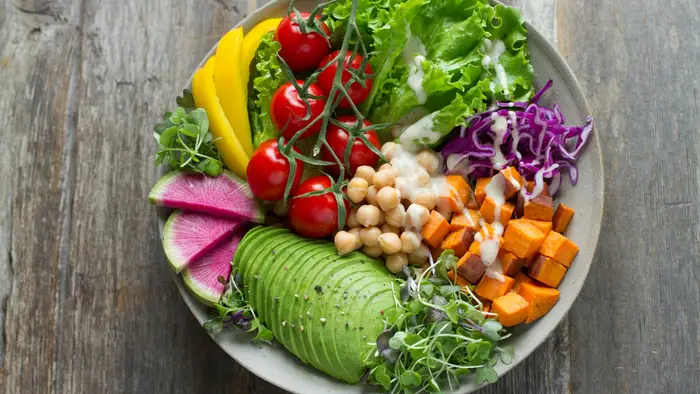
A bowl of fresh vegetables. Bland, easily digested food can settle a stomach and lift blood sugar; a heavy greasy meal the morning after mostly adds work for an already irritated gut.
What actually helps, and what does not
If there is no cure, the next question is what genuinely helps, and here the evidence is more encouraging than the folklore suggests, because several modest measures do make the wait more bearable. The first and least glamorous is time. Ireland’s Health Service Executive notes that a hangover will usually pass after 8 to 24 hours, and that remains the only reliable endpoint. Everything else is comfort care while the body finishes its work.
Hydration helps, within its limits. Water before bed and through the next day eases the thirst and dizziness of dehydration, and drinks containing electrolytes — sports drinks, oral rehydration sachets — replace sodium and potassium lost through increased urination, and tend to hydrate more effectively than plain water alone. Bland, easily digested food helps too: toast, crackers, bananas, and thin vegetable broth can settle an upset stomach and lift blood sugar, while sugary foods can help if a person feels shaky. Sleep, even a daytime nap, helps restore some of what the fragmented night took away. For headache, an anti-inflammatory painkiller such as ibuprofen or aspirin, taken with food, is generally considered the safer choice, with acetaminophen best avoided while alcohol is still being processed.
Just as useful is knowing what does not help, because the morning-after marketplace is crowded with confident claims. Coffee will make a person feel more alert, but it is a diuretic that can worsen dehydration and anxiety, and it does nothing to clear alcohol faster. A large greasy breakfast, the traditional fry-up, is often credited with absorbing alcohol, but food only slows absorption before drinking; once alcohol is in the bloodstream, no meal can remove it or speed its metabolism, and a heavy meal may simply irritate an already inflamed stomach. Vitamin supplements taken the morning after have weak clinical support for hangover relief, despite alcohol’s depletion of B vitamins. The pattern is consistent: the remedies that feel most decisive tend to be the ones with the least evidence, and the measures with genuine support tend to be the boring ones.
Prevention, unglamorous as ever, outperforms all of them. Eating a substantial meal before drinking slows absorption and lowers the peak blood alcohol level. Alternating each alcoholic drink with a glass of water reduces both total intake and dehydration. Pacing to roughly one standard drink per hour respects the liver’s processing rate. Choosing lighter-coloured drinks over dark, congener-heavy ones reduces the severity of the next morning. And stopping before the body’s overnight capacity is exceeded is, as the British Medical Journal authors concluded, the most effective strategy of all. None of this is as fun as a folk remedy. All of it works better.

Hands on a laptop beside a stethoscope. Hangover cures spread online in minutes; the trials that test them take years, and most of them come back negative.
Why the myth refuses to die
It is worth asking, finally, why a remedy with no evidence and a five-century pedigree keeps surviving every attempt to kill it. Part of the answer is the timing trick described above: it genuinely feels good for an hour, and human beings are excellent at remembering relief and forgetting the relapse. Part of it is social. Hair of the dog is usually offered, not sought: it arrives as a joke, a bonding ritual, a way of extending the night’s camaraderie into the morning. Refusing it can feel like refusing the group. And part of it is the deep appeal of sympathetic magic itself — the idea that the thing that hurt you, taken in a smaller dose, will heal you. That idea predates science, it feels intuitively fair, and it shows up everywhere from homeopathy to the phrase “fight fire with fire.” Intuition is a poor pharmacologist.
There is also a commercial ecosystem keeping the broader hangover-cure market alive. Supplements, electrolyte drinks, vitamin patches, and “recovery” tonics promise to do what medicine cannot, and their marketing borrows the language of science without its discipline. The British Medical Journal review is now two decades old, but its central finding has not been overturned: no compelling evidence exists for any hangover intervention. Newer products arrive regularly, and some show small signals in small trials, but none has produced the replicated, large-scale evidence that would change the guidance of health authorities. Until one does, the honest advice remains the boring advice.
The morning after will always produce a market for miracles, because a hangover is one of the few miseries that is both entirely self-inflicted and entirely predictable, and the desire to undo it is powerful. That desire is exactly what the hair-of-the-dog ritual exploits. It offers a story in which the damage can be undone by the same hand that caused it, a story with a punchline and a second round. The body, unfortunately, does not tell stories. It processes chemicals at a fixed rate, it clears toxins in a fixed order, and it keeps the receipt.
A phone showing a search screen. Most hangover advice is encountered mid-misery, at the moment when a quick fix sounds most convincing and the evidence sounds least welcome.
The morning after, honestly
So the next time someone slides a beer across the table with a grin and a proverb, it is worth knowing what is actually being offered. Not a cure, but a delay. Not a treatment, but a mask. Not a way out of the hangover, but a way of borrowing an hour of comfort from the afternoon and paying it back, with interest, later in the day. The drink will feel like it worked, right up until it stops working, and that interval — that warm, deceptive hour — is the whole business model of the myth.
The real cure has no proverb attached to it, which may be why it has never caught on as a slogan. Drink less, or not at all. Eat before you drink. Alternate with water. Sleep properly. Wait. It is the advice that doctors give, that health services print, and that systematic reviews confirm, and it is spectacularly unmarketable precisely because it cannot be bottled, branded, or poured into a glass at ten in the morning. But it is the only advice that survives contact with the evidence. The dog that bit you cannot heal you. It can only bite you twice.