No, Glass Is Not a Slow-Moving Liquid: Why Old Windows Are 'Thicker at the Bottom'
There is a piece of science trivia that has traveled through classrooms for generations, usually delivered in the voice of someone who has just learned something delicious: glass is not really a solid — it’s a liquid that flows so slowly we can’t see it move. The proof, they add, is all around us. Look at the windows of any old church or medieval building: the panes are thicker at the bottom than at the top, because centuries of gravity have dragged the glass downward.
It is one of the most elegant myths in popular science, because the evidence seems to be visible to anyone who runs a finger along an old pane. And it is entirely wrong.
ProofNews examined the claim, reviewed the materials-science research and the history of window making, and found that glass at room temperature does not flow on any timescale that matters. The thicker bottoms of old windows were not sculpted by time. They were sculpted by glassblowers, by the physics of handcraft, and by the deliberate choices of the glaziers who installed them.
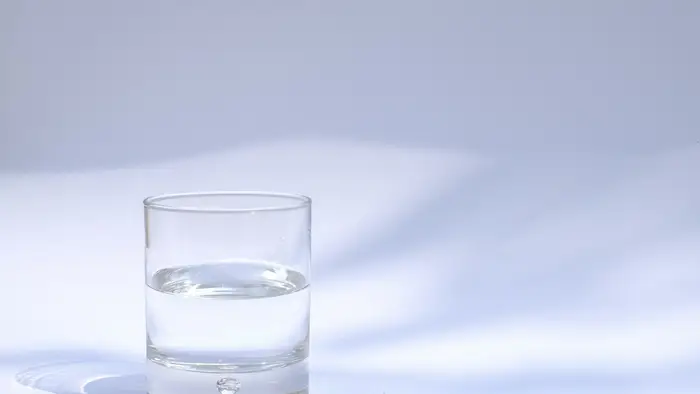
An ordinary drinking glass holds its shape indefinitely at room temperature — and laboratory measurements say that is exactly what the physics predicts.
The Claim: Old Windows Are Thicker at the Bottom Because Glass Flows
The myth comes in two linked parts. The first part is the observation: panes of glass in old churches, cathedrals, and colonial-era houses are often noticeably thicker along their bottom edges than along the tops. Anyone who has pressed their nose against a wavy old window has seen it — the rippled, uneven surface, the glass that seems to bulge slightly near the sill.
The second part is the explanation people are handed for it: glass, we are told, is technically a liquid — or, in the more scientific-sounding version, an “amorphous solid” caught somewhere between the liquid and solid states — and over hundreds of years it has oozed downward under its own weight. It is sometimes called the “supercooled liquid” story, and it has been repeated in school lessons, popular-science books, and casual conversation for decades.
The myth even comes with a satisfying air of sophistication. Believing it makes you sound like someone who knows that states of matter are messier than the textbooks admit. Unfortunately, the sophistication is misplaced. According to the scientists who study glass for a living, the thickness difference is real — but the flow never happened.
Where the Myth Came From: A “Frozen” Fact, Thawed by Retelling
The idea that glass is a slow liquid has two separate roots, and understanding them is the key to the whole story.
The first root is a misreading of real science. The German physicist Gustav Tammann (1861–1938), a pioneer of the physics of glass, described glass as a “frozen supercooled liquid.” The label is technically precise: when molten glass cools, it does not crystallize the way most substances do. Instead, the disordered, liquid-like arrangement of its atoms gets locked in place — frozen — as the material hardens. The myth took that phrase, kept the “liquid,” and quietly dropped the “frozen,” which was the entire point. As one physics explainer puts it, the notion that glass is a liquid comes in part from this “erroneous reading” of Tammann’s phrase, which “referred to it as a ‘frozen supercooled liquid.’ The myth omits the ‘frozen’ part.”
The second root is the wavy old window itself. Once people were told that glass might be liquid-like, the thicker bottoms of antique panes looked like Exhibit A. Cause and effect wrote themselves: the glass must have flowed.
But the flow story has a problem that should have been obvious from the start. If gravity were truly dragging window glass downward over centuries, then it should drag everything made of glass downward. It doesn’t. Glass vessels from ancient Egypt show none of the supposed sagging, as the antique-glass researcher Robert Brill of the Corning Museum of Glass has pointed out. Roman and Egyptian glassware buried for two millennia still fits together without distortion. And astronomers’ telescope lenses — precision-ground pieces of glass — keep focusing light perfectly for decades, which would be impossible if the glass beneath them were creeping along like a slow liquid.
So if the glass never flowed, what made the bottoms thicker? The answer is the glassmakers themselves.

Before it became windowpanes, window glass began as ordinary sand — mostly silica — melted in a furnace. How that molten silica was shaped, centuries ago, is what made old windows uneven.
How Medieval Window Glass Was Actually Made
For most of the centuries in which the famous “thicker at the bottom” windows were built, flat glass was a handmade luxury, and the hand shows in every pane.
The dominant technique from the Middle Ages through the early 19th century was crown glass. A glassblower would gather a blob of molten glass on a blowpipe, blow it into a hollow globe, transfer it to a metal punty rod, reheat it, and spin it rapidly. Centrifugal force opened the globe into a flat disk — the “crown” — up to five or six feet across. The disk was then cut into the panes that filled the window.
This process was ingenious, but it was inherently lopsided. The glass ended up thinnest in a band near the rim of the disk and grew thicker and more opaque toward the center, where the punty rod had attached — the thick nub known as the bullseye. The best, clearest panes were cut from the outer edges; the thick, bubbly center glass went into cheaper windows, or was prized as a decorative feature.
The other major method was cylinder glass (also called broad or muff glass). The blower elongated the globe into a cylinder by heating, blowing, and swinging it in a trench, then split the cooled cylinder lengthwise and flattened it on a tabletop. The result was never perfectly uniform: every pane carried the wavy, rippled “patina” of the handmade process, with thickness varying from one edge to the other and with bubbles, streaks, and tool marks trapped inside.
Here is the crucial part. When a glazier received these handmade panes — none of them perfectly flat, many of them visibly wedge-shaped — he had to mount them in a lead lattice inside a wooden or stone frame. And when the pane was uneven, craftsmen followed the same instinct that anyone hanging a heavy picture follows: put the heavy side down. The thicker, heavier edge went at the bottom of the frame, where it sat most stably in the lead came and where the weight was best supported. For crown glass, glaziers deliberately installed panes with the thicker side down for stability, and for cylinder glass, the same practical logic applied to wedge-shaped pieces.
The result, seen today, is a window that looks exactly as if the glass has been flowing downward for centuries. But the flow happened in the opposite direction of time: the thickness was there on day one, placed there by a craftsman.
Historians of glass are emphatic on this point. The Corning Museum of Glass, the institution most associated with the scientific study of glass, has explained that medieval glassmakers produced uneven panes because of their primitive manufacturing methods, and that glaziers intentionally installed the heaviest edge downward for stability. The Newport Restoration Foundation, writing about 18th-century windows, reported the same explanation after consulting Stephen Koob and Dr. Robert Brill at the Corning Museum of Glass: the thicker-at-the-bottom appearance “is due to the original form of the glass, which in turn is due to its method of manufacture” — not to any movement of the material over time. Historic New England, which stewards dozens of houses with antique windows, puts it even more plainly: “The distinctive patina of crown and cylinder glass is not the result of time but the handmade methods used to create it.”
And here is the observation that should have killed the myth decades ago: not all old windows are thicker at the bottom. If glass were flowing, every pane in every old building would sag the same way. In reality, the thick side sometimes appears on the left, sometimes on the right, and sometimes not at all — exactly the pattern you would expect from craftsmen working with handmade, variable material, and exactly the pattern you would not expect from a universal physical process.

A modern smartphone screen — made from chemically strengthened glass — is a cousin of the window glass in medieval churches. Even in high-tech glasses, measurable room-temperature movement is minuscule and says nothing about old windows.
What Glass Really Is: An Amorphous Solid, Not a Slow Liquid
The physics of the myth deserves its own look, because there is a genuine subtlety here — and the myth feeds on it.
Glass is classified as an amorphous solid. Unlike ice or quartz, whose atoms sit in repeating crystalline order, glass has no long-range order. Its atoms are arranged in a disordered tangle, roughly the way they were arranged in the molten liquid — but unlike in a liquid, those atoms are chemically bonded to each other and locked in place. The UCSB Science Line answers the question directly: “a GLASS is frozen liquid… So a glass is a solid; but it can also be described as a frozen liquid (of very high viscosity).”
That parenthetical matters. Viscosity is the measure of a fluid’s resistance to flow, and the viscosity of window glass at room temperature is astronomically high — far beyond anything that behaves like a liquid in any practical sense. The material most similar to glass, chemically and physically, is quartz: a crystal that nobody would dream of calling a liquid. The difference is structure, not substance, and the Corning Museum’s conservation scientists say plainly that glass “does not display any characteristics of a liquid.”
The deeper question is how we know. Scientists do not just assert this; they measure it. And in 2026, researchers did something remarkable: they calculated, from the actual properties of medieval glass, just how slowly a cathedral window would flow.
The 2026 Measurement: Westminster Abbey’s Windows, Tested
The most decisive evidence comes from the glass itself. A team of glass scientists at Corning — Ozgur Gulbiten and John Mauro (now at Penn State University), working with colleagues — set out to calculate the rate of glass flow in medieval windows using the most advanced tools available. They based their measurements on actual medieval glass: windows in Westminster Abbey dating to 1268 AD, nearly 760 years old.
Their findings, described by the American Ceramic Society and published in the Journal of the American Ceramic Society, are the highest-ever direct measurements of glass viscosity at low temperatures. And they contain a surprise that shows science at its best: the researchers found that medieval glass actually has a lower viscosity at room temperature than expected — some sixteen orders of magnitude lower than previous estimates, which had been based on ordinary soda-lime glass. If you wanted evidence that glass could flow, this was your best shot.
But the number, even reduced, is still overwhelming. The authors’ conclusion: the viscosity is still “much too high to observe measurable viscous flow on human time scale.” In other words, even with the most favorable measurement ever made of real medieval glass, the glass in those 1268 windows will not flow measurably during any span of time humans can observe. The myth’s own best evidence — actual cathedral glass — says no.
The result fits with decades of earlier work. Mark Ediger, a chemistry professor at the University of Wisconsin–Madison, explained the timescale to Scientific American with a striking calculation: a mathematical model shows it would take longer than the universe has existed for room-temperature cathedral glass to rearrange itself enough to appear melted. Cathedral glass sits hundreds of degrees below its glass-transition temperature — the temperature range where the atoms are mobile enough to rearrange — and at room temperature its molecules move so slowly that, for practical purposes, they do not move at all.
Another line of evidence comes from a completely different kind of glass. In 2013, chemical engineers at Texas Tech University studied the stress relaxation of a 20-million-year-old specimen of Dominican amber — a natural glass that has sat near room temperature for geological time. They found that its atoms behaved exactly as a solid locked into place below its glass-transition temperature should behave, reaffirming that glass does not flow at room temperature even over millions of years.
Consider what this implies. If glass cannot measurably flow over 20 million years in amber, and over 760 years in Westminster Abbey’s windows, then the thicker bottoms of old panes — plainly visible to the eye — cannot be the product of flow. They must be the product of manufacture. The two lines of evidence converge on the same answer.

Telescope lenses — precision-ground glass — focus light flawlessly for decades. If glass were a slow liquid, every observatory in the world would be slowly going out of focus.
The Honest Nuance: Do Glasses Move at All?
A fair reader might ask: if the myth is false, why do serious scientists ever talk about glass “relaxing” or “flowing” at room temperature? The answer is that there is a small kernel of real science here — and it is worth getting right, because exaggerating it in either direction would be its own kind of misinformation.
In specialized, high-performance glasses — the kind engineered for extreme thinness and strength, like the glass covering a phone screen — researchers have detected tiny long-term deformations at room temperature. Corning observed a one-square-meter sheet of Gorilla Glass shrink by about five micrometers over ten days (and a little more over the following eighteen months). A team at the UCLA Henry Samueli School of Engineering and Applied Science, led by Mathieu Bauchy, modeled why such relaxations happen: in complex glasses, chemical elements of different sizes compete inside the atomic network — the “mixed-alkali effect” — and their simulations suggested that very large panes of high-tech glass could deform by roughly ten micrometers per year in their first months of life, enough to matter for giant display screens.
To put those numbers in perspective: a human hair is about 50 to 100 micrometers thick. The measured “flow” is a small fraction of a hair’s width, per year, in the most susceptible engineered glasses, during their earliest months — and it slows dramatically with time. It is a genuine phenomenon of materials science, and engineers care about it. But it has precisely nothing to do with the myth. It is hundreds of orders of magnitude too small to explain a visibly thicker windowpane, and the 2026 measurements on actual medieval cathedral glass — the very glass the myth is about — show no observable flow on any human timescale.
This is why scientists draw a firm line. Liquids flow when even a small force is applied, however slowly; solids may deform under force but return to their shape when the force is released — and that is how glass behaves at room temperature. If you bend a drinking glass, it springs back (or breaks). It never droops. The distinction is not pedantry; it is the difference between the two states of matter.

The timescale on which room-temperature window glass could visibly rearrange itself is longer than the age of the universe — which is why the thickness you see in old windows was put there by hand, not by time.
The Verdict
The claim that glass is a slow-moving liquid — and that old windows are thicker at the bottom because the glass has flowed downward over the centuries — is False.
The evidence runs along three independent lines, and they all arrive at the same place:
- The manufacturing record. Medieval and early-modern window glass was handmade by the crown and cylinder methods, which produced panes of inherently uneven thickness. Glaziers deliberately mounted the thicker, heavier edge at the bottom for stability. The thicker bottoms were present on the day the windows were installed — and not every old window shows them, which is exactly what you would expect from craftsmen working with handmade material and not at all what you would expect from a universal physical process.
- The physics. Glass is an amorphous solid: a disordered, bonded atomic network whose atoms are locked in place at room temperature, hundreds of degrees below the glass-transition temperature where movement becomes possible. It does not display the characteristics of a liquid.
- The measurements. The most direct study ever conducted — 2026 viscosity measurements on actual 1268 AD medieval glass from Westminster Abbey, published in the Journal of the American Ceramic Society — found the viscosity far too high for measurable flow on any human timescale. A separate model puts the time for visible rearrangement of cathedral glass at longer than the age of the universe, and a 20-million-year-old amber glass confirms that room-temperature glass behaves as a solid over geological time.
What gives the myth its staying power is the grain of truth it started from. Glass really is an odd material — an “amorphous solid” that never crystallized, a liquid-like structure frozen in place. The German physicist Gustav Tammann really did call it a “frozen supercooled liquid.” But the word that matters in that phrase is frozen, and the myth survives by leaving it out.
Why the Myth Matters — and What to Check on Next Time
It might seem harmless: a bit of wrong trivia about old windows. But the glass myth is a textbook case of how misinformation actually works. It did not begin as a lie. It began as a genuine scientific label (“frozen supercooled liquid”) stripped of its qualifier, combined with a real observation (uneven old windows) that had a real but different cause (handmade glass, mounted thick-side-down). Each retelling kept the parts that sounded amazing and dropped the parts that required explanation. The result is a claim that feels like sophistication and functions like folklore.
The lesson travels well beyond windowpanes. Whenever a claim rests on a single striking observation — the thicker bottom of a pane, a chart on social media, a screenshot of a document — ask what the observation’s boring explanation might be. The glassblower’s spinning disk, the cylinder split and flattened on a tabletop, the glazier’s pragmatic choice of which edge goes down: none of these is as poetic as glass flowing like a river of time. But they have the advantage of being true — and, unlike the myth, they were measured.
ProofNews verdict: False. Glass is an amorphous solid at room temperature; old windows are thicker at the bottom because of how they were made and mounted, not because the glass flowed.