No, Einstein Did Not Fail Math in School — His Report Card Shows the Exact Opposite
You have seen the meme. A faded photograph of Albert Einstein, hair wild, tongue out or staring into the distance, with text underneath promising that the greatest genius of the twentieth century once failed mathematics in school. The moral lands instantly: if Einstein could flunk math and still rewrite physics, then your own report card is no reason to despair.
It is comforting. It is shareable. And it is not true.
Einstein never failed mathematics. Not in primary school, not at the gymnasium in Munich, not at the cantonal school in Aarau. His surviving school records show him earning the highest possible marks in algebra, geometry, and physics. When he was shown a newspaper column repeating the claim during his lifetime, he laughed it off and corrected the record himself. Yet the story refuses to die. It has survived for the better part of a century — outliving Einstein himself — because it feeds something deeper than facts: the hope that genius can arrive from anywhere, even from the bottom of the class.
This is the anatomy of a myth: where it came from, what the evidence actually says, and why a false story about failure became more popular than the true story of extraordinary early achievement.
The Claim
The claim appears in many forms. The gentlest version says Einstein was “bad at math” as a child. The bolder version says he failed it outright. Motivational posters pair his portrait with lines like “he failed math in school — and then changed the world.” Some versions specify that he flunked grade-school arithmetic; others move the failure to high school or to a college entrance examination.
All of these versions share the same core assertion: that the man who formulated special and general relativity, theories built on formidable mathematics, was at some point a failure at mathematics itself.
There is a certain appeal to the paradox. If even Einstein struggled with numbers, then mathematics must be conquerable by anyone, and genius must be about something other than classroom performance. The claim flatters its audience. That flattery is worth keeping in mind, because it helps explain why the story has been repeated so much more eagerly than the dull truth has been checked.
The Afternoon Einstein Laughed at the Legend
The myth is old enough that Einstein himself had to deal with it. In 1935, the American newspaper feature Ripley’s Believe It or Not! ran an item headlined “Greatest Living Mathematician Failed in Mathematics.” A rabbi in Princeton showed the clipping to Einstein, presumably expecting a chuckle of recognition at a harmless exaggeration.
Einstein laughed — but not in recognition. He corrected it on the spot: “I never failed in mathematics,” he said. “Before I was fifteen I had mastered differential and integral calculus.”
The quotation survives in Walter Isaacson’s biography Einstein: His Life and Universe, and it is worth pausing over what it claims. Differential and integral calculus — the mathematics of rates of change and accumulated quantities, the toolkit of Newton and Leibniz — is a subject most students meet in their final years of secondary school or their first years of university. Einstein was saying he had it under control before his fifteenth birthday, in an era when formal instruction in the subject came years later than it does now.
This is not the testimony of a man being modest about a youthful stumble. It is a flat denial, offered with amusement, backed by a specific and checkable boast. And the school records, it turns out, support him completely.

The Report Card, Read Correctly
The single most cited “evidence” for the myth is Einstein’s own school-leaving certificate — and it is the myth’s most embarrassing exhibit, because the document proves the opposite of what the myth claims.
In September 1896, the seventeen-year-old Einstein sat the examinations for his Maturitätszeugnis, the Swiss certificate of maturity, at the cantonal school in Aarau. The certificate, issued by the Council of Education of the Canton of Aargau on October 3, 1896, lists his grades subject by subject:
German language and literature: 5. French language and literature: 3. Italian: 5. History: 6. Geography: 4. Algebra: 6. Geometry: 6. Descriptive geometry: 6. Physics: 6. Chemistry: 5. Natural history: 5. Artistic drawing: 4. Technical drawing: 4.
Here is the catch that has confused generations of readers: on the Swiss grading scale of the time, 6 was the highest possible mark and 1 the lowest. An American or British reader, accustomed to a system in which higher numbers mean worse performance on some scales — or simply expecting failure to look like low numbers — sees a row of 6s and reads catastrophe. What the document actually records is triumph. In every mathematical subject on the certificate — algebra, geometry, descriptive geometry — and in physics, Einstein received a 6. The highest grade available. The overall average of his thirteen graded subjects was exactly 5, officially classified as “good.”
He did not merely pass mathematics. He topped it, repeatedly, on the official record, at the end of his secondary schooling. The lowest marks on the page belong to French and the drawing subjects — languages and art, not numbers.
So how did a document full of top marks become the myth’s star witness? The answer lies in a quirk of nineteenth-century European education: grading scales were not standardized across borders. The Luitpold Gymnasium in Munich, where Einstein had studied before moving to Switzerland, used the opposite convention — there, 1 was the highest mark and 6 meant failure. Readers comparing his Munich marks with his Aarau marks, or simply assuming that a 6 everywhere meant disaster, read Swiss excellence as German catastrophe. One popular telling puts it plainly: biographers working with transcripts from the two schools mistook top Swiss grades for failing German ones. Another theory, less certain but often repeated, suggests that the school itself reversed its scale in 1896, making his final-year 6s look like a sudden collapse to anyone comparing them with earlier years.
Whatever the exact mechanism, the confusion is understandable — and it was decisive. A report card that should have ended the rumor became, through misreading, the rumor’s favorite piece of evidence.
The Examination He Actually Failed
If the myth contains any grain of truth at all, it is here — and it is worth examining precisely, because the grain has been so thoroughly misdescribed.
In October 1895, at sixteen, Einstein sat the entrance examination for the Swiss Federal Polytechnic in Zurich, the institution known today as ETH Zurich. He was not supposed to be there at all. The Polytechnic required applicants to be eighteen and to hold a secondary-school diploma; Einstein had neither. He had left the Luitpold Gymnasium in Munich the previous year, spent months with his family in Italy, and was effectively a year of formal schooling short. A family friend, the banker Gustav Maier, wrote to the Polytechnic’s director, Albin Herzog, on the boy’s behalf, calling him a wunderkind. Herzog, with misgivings, granted special permission for the sixteen-year-old to attempt the examination anyway.
Einstein failed it. The preserved records of the attempt show where: his strongest results were in mathematics and the natural sciences, exactly as the legend gets backwards. What sank him were the general subjects — languages, history, and the essay — the parts of the examination that assumed a finished secondary education he had not yet received.
Even in defeat, the faculty saw what mattered. Friedrich Weber, a physics professor at the Polytechnic, was impressed enough to invite the sixteen-year-old to attend his lectures. Director Herzog himself advised Einstein to complete his secondary schooling at the cantonal school in Aarau and return properly credentialed. Einstein followed the advice, spent the 1895–96 year at Aarau — where he earned that certificate full of 6s — and enrolled at the Polytechnic in 1896, at seventeen, in the four-year program training teachers of mathematics and physics.
Read that again: the examination Einstein failed is the one in which mathematics was among his best subjects. The myth has taken an episode in which a sixteen-year-old boy, admitted as an exception, dominated the mathematics section of a university entrance exam and been flattened by the language sections — and retold it as “Einstein failed math.” It is not a simplification. It is an inversion.
The Schoolboy Who Outpaced the Syllabus
The school records only begin to capture how unusual Einstein’s early mathematical life was. By the accounts of his family and his biographers, his real education in the subject happened ahead of — and largely outside — the classroom.
At twelve, he decided to find out whether he could learn geometry and algebra on his own. His parents bought him the textbooks, and over a single summer he worked through both subjects, devising his own proofs for the theorems he studied — including his own proof of the Pythagorean theorem, discovered independently before he ever saw the classical one. His uncle Jakob Einstein, an engineer, had introduced him to algebra, and the boy took to it with an intensity that surprised the adults around him.
At twelve he also began calculus, roughly three years ahead of the classmates who would eventually be qualified to study it. Einstein himself later described skipping classes in favor of studying the masters of theoretical physics at home “with a holy zeal.” This was not a student rescued from mathematical mediocrity by late-blooming effort. It was a student for whom the standard curriculum moved too slowly, and who simply walked ahead of it.
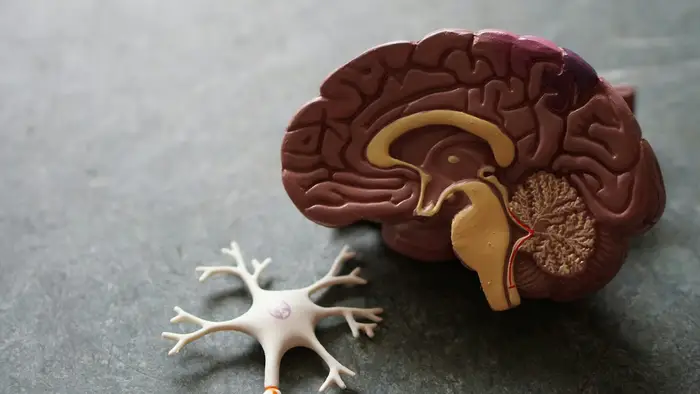
Decades of later research would add a curious footnote. Neuroanatomical studies of Einstein’s preserved brain found it to be of average overall weight — 1,230 grams — but noted unusual features in the parietal lobes, the regions most associated with mathematical, spatial, and visual reasoning, including a higher density of glial cells and the absence of a standard lateral sulcus. Correlation is not destiny, and no brain scan explains relativity. But the findings sit oddly beside the image of a boy who could not do sums.

The Student Who Was Brilliant and Difficult
None of this means Einstein was a model student. He was, by many accounts, a difficult one — and honesty about the myth requires honesty about that too.
He chafed at rote learning and military-style discipline at the Luitpold Gymnasium, and he left before finishing. At the Polytechnic, he skipped lectures he considered dull and infuriated at least one professor with his independence. Walter Isaacson’s biography recounts that Jean Pernet, who taught the laboratory course Physical Experiments for Beginners, gave Einstein a 1 — the lowest possible grade on the scale then in use — and that the faculty issued Einstein an official director’s reprimand in March 1899 for lack of diligence in the physics practicum. The failing grade, in other words, was real — but it was a penalty for not showing up to laboratory exercises, not for failing to understand them.
That distinction is the whole story in miniature. Einstein failed at being a conventional student: at attendance, at deference, at subjects he considered pointless. He did not fail at mathematics. When his supporters at the Polytechnic looked past the attitude problem, they found a young man whose grasp of the mathematics of physics was already formidable — formidable enough that when he needed the heavy machinery of tensor calculus and Riemannian geometry for general relativity years later, he could absorb it with the help of his friend and former classmate Marcel Grossmann, who supplied the lecture notes Einstein had skipped taking himself.
There is also a temptation to “split the difference” — to grant that he was good at math but insist he was bad at school math, or that his genius was purely conceptual. The records do not support even that retreat. The 6s on the Matura certificate are school mathematics, graded by schoolteachers, and he aced them.
Why the Myth Refuses to Die
A falsehood this thoroughly documented should have died decades ago. It survives because it does cultural work that the truth cannot do.
First, it comforts. A struggling student, a worried parent, a teacher looking for an encouraging word — all find relief in the thought that the century’s greatest physicist once stumbled where they are stumbling. The myth converts Einstein from a remote prodigy into a late bloomer, and late bloomers are easier to love, and easier to believe in.
Second, it flatters a certain suspicion of formal education. If even Einstein failed math, the story suggests, then perhaps the system’s judgments are arbitrary, perhaps grades measure obedience rather than ability, perhaps the classroom is the enemy of genius. There is a real critique of rote schooling embedded in Einstein’s actual biography — he really did hate the drill-and-discipline style of his Munich school. The myth simply grafts that valid critique onto a false transcript.
Third, the myth is perfectly shaped for the internet. It is short, surprising, and morally satisfying — the three ingredients of a viral factoid. Each retelling sheds a little context: “failed the entrance exam’s general section at sixteen without a diploma” becomes “failed an exam” becomes “failed math” becomes “failed math in school.” The Ripley’s column that started the modern version in 1935 was already a compressed, sensationalized product; ninety years of memes have compressed it further.
And fourth, the truth is boring by comparison. “Gifted child masters calculus at fourteen, earns top marks, revolutionizes physics” is not a story that helps anyone feel better about a bad grade. It is, however, the story the evidence supports.
The Myth’s Traveling Companions
The failed-math story rarely travels alone. It usually arrives in a convoy of other Einstein legends, and it is worth checking the companions too, because they reveal the same pattern: a real detail, stretched until it snaps.
One companion claims Einstein did not speak until he was four, offered as proof that he was a “late developer” in everything. Family accounts do report that his speech development was unusually slow, and the story is repeated in biographical writing — but a late start in speaking says nothing about mathematical ability, and Einstein’s own school records show no corresponding delay in his studies. It is a biographical curiosity, not an academic record.
Another companion says he became a patent clerk because academia rejected him — implying a broader pattern of failure. The outline is true: after graduating from the Polytechnic in 1900, Einstein struggled to find an academic position and took a job at the Swiss patent office in Bern in 1902, where he remained until 1909. But the implication is misleading. The patent office years were among the most productive of his life: 1905, his annus mirabilis, produced the papers on the photoelectric effect, Brownian motion, special relativity, and mass-energy equivalence — all written while he was examining other people’s inventions by day. The clerkship was not the exile of a failed student. It was the day job of a young physicist doing epochal work in his spare hours.
A third companion, darker, claims his first wife Mileva Marić deserved co-credit for relativity, or conversely that her own examination failure proves the couple’s story is murky. The documented facts are narrower: Marić, the only woman in their Polytechnic mathematics-and-physics cohort, failed the 1900 diploma examination with a poor grade in the mathematics component, theory of functions, while Einstein passed. Historians of physics who have examined the collaboration claims find no evidence she made substantive contributions to the 1905 papers. What the episode actually illustrates is the opposite of the myth’s moral: in the one examination where someone in Einstein’s orbit genuinely stumbled in mathematics, it was not Einstein.
Each of these stories follows the same recipe — take a true fragment (a failed entrance exam, a late start in speech, a patent-office job), remove the context, and invert the meaning. The math myth is simply the most successful dish the recipe ever produced.
The Verdict
False. The claim that Albert Einstein failed mathematics in school is contradicted by every piece of primary evidence available.
His 1896 maturity certificate from the cantonal school in Aarau — issued by the Council of Education of the Canton of Aargau after written and oral examinations — awards him the highest possible grade, a 6 on the Swiss scale, in algebra, geometry, descriptive geometry, and physics. His weakest marks were in French and drawing. When shown a 1935 Ripley’s Believe It or Not! item repeating the claim, Einstein himself denied it and stated that he had mastered differential and integral calculus before age fifteen. Biographical accounts describe him teaching himself algebra and Euclidean geometry over a single summer at twelve and beginning calculus the same year.
The myth’s ingredients are identifiable: a genuine examination failure (the 1895 Polytechnic entrance exam, failed on languages and general subjects while mathematics was among his best sections), a genuine grading-scale confusion between Munich and Aarau that made top Swiss marks look like failures, and a 1935 newspaper column that Einstein personally refuted. None of them amounts to failing mathematics. What the record shows, consistently, is a student who was impatient with schooling and extraordinary at the subject in question.
There is an irony worth sitting with. The people who share the myth mean well — they want to tell struggling students that a bad grade is not a verdict on their future. That is a fine message, and it does not need a false Einstein to carry it. Plenty of genuinely great scientists struggled in school; the physicist’s own friend Marcel Grossmann kept the lecture notes Einstein was too restless to take. But borrowing Einstein’s name for a failure he never had does not just misstate history. It erases the actual lesson of his youth: that deep, self-directed work in mathematics — the summer of geometry at twelve, the calculus at fourteen — was the foundation on which everything else was built.
Einstein did not succeed despite failing math. He succeeded, in large part, because he never did.

Sources consulted for this fact-check include Einstein’s 1896 maturity certificate grades as documented by multiple biographical accounts; Einstein’s 1935 response to the Ripley’s column as quoted in Walter Isaacson’s Einstein: His Life and Universe; ETH Zurich’s archived records of the 1895 entrance examination; and contemporary debunkings published by Today I Found Out, Mental Floss, and Commonplace Facts.