No, Diamonds Don't Come From Coal: The Real Origin of the World's Hardest Gem
In the 1983 film Superman III, the Man of Steel performs a party trick that has stuck in the cultural imagination for more than forty years. Handed a lump of coal, he squeezes it in his fist, applies a little superhuman pressure, and opens his palm to reveal a sparkling diamond. The scene takes only a few seconds. For millions of viewers — including plenty of schoolchildren — it planted an idea that felt too elegant to question: diamonds are just coal that got squeezed hard enough, for long enough.
The idea did not start with Hollywood. Generations of students have been taught, in classrooms and in well-meaning trivia books, that coal under enough pressure becomes diamond. It is one of those “facts” that travels from grandparent to grandchild without anyone checking the receipt, because it feels right. Coal is carbon. Diamonds are carbon. Pressure makes hard things harder. The logic writes itself.
The logic is also wrong. According to geologists, natural diamonds have essentially nothing to do with coal. They form far deeper than any coal deposit could ever be buried, from carbon sources that existed billions of years before the first coal-forming plants ever grew. Most of the diamonds on Earth crystallized before complex life had barely begun, let alone before swamps of ferns and trees were being buried to make coal. The two substances share an element and a headline-writer’s convenience, and not much else.
ProofNews examined the claim that diamonds are formed from coal, reviewed the geological research and the history of the myth, and reached the verdict that it is false. What follows is how the misunderstanding started, where diamonds genuinely come from, what coal genuinely is — and why one of science’s most persistent myths refuses to die.

A starry night sky over a dark mountain silhouette — a reminder of deep time. Most diamonds formed billions of years before the first coal-forming plants existed.
The Claim: Squeezed Coal Becomes Diamond
The version of the myth most people absorb goes something like this: plant matter dies, gets buried, and becomes coal; the coal gets buried deeper; pressure and heat squeeze it; and eventually it becomes diamond. It is a tidy three-step story, and tidiness is exactly what makes it spread. It slots neatly into the way we learn about the rock cycle, and it gives coal — a fuel we mostly associate with soot and smoke — a glamorous redemption arc.
The claim has been repeated in school textbooks, trivia quizzes, jewelry store pamphlets, and countless internet explainers. A jewelry industry site put the “expert” version of the story in circulation for years: that coal is the starting material and pressure does the rest. The Superman III scene simply dramatized what people already half-believed. As the science writers at The Naked Scientists once noted, Superman’s coal-crushing trick “helped to reinforce the idea that coal — which is basically carbon — can be converted into diamonds, which are also made of carbon, by applying enough pressure.” The catch, they added, is that “the idea that diamonds are made from coal is fictional.”
That is not a minority view. Openly consult almost any geology textbook and you will find the same correction. An open-access physical geology textbook used in university courses states plainly that diamonds form deep in the mantle “from carbon that is naturally present in mantle rock (not from coal)” — the parenthetical doing heavy, exasperated lifting. The myth is so entrenched that scientists feel compelled to rule it out by name.
What Diamonds Actually Are
To understand why the myth fails, it helps to start with what a diamond is. A diamond is carbon, and almost nothing else: roughly 99.95 percent pure carbon, arranged in one of the most orderly crystal lattices in nature. Each carbon atom bonds to four neighbors in a rigid three-dimensional tetrahedral structure. That structure is the entire secret of the diamond’s famous hardness — the hardest naturally occurring substance known. Scratch it against anything else and the other thing loses.
Crucially, being made of carbon does not make a diamond a relative of coal any more than being made of carbon makes it a relative of you. Graphite — the soft gray stuff in pencil lead — is also pure carbon. So is soot. So is the charcoal on a barbecue. The difference between these materials is not what they are made of but how the atoms are arranged. In graphite, carbon atoms form flat sheets held together by weak forces, which is why graphite smears and crumbles. In diamond, the atoms lock into a three-dimensional fortress. Coal, for its part, is a chemical mess by comparison: a sedimentary rock built from dead plant matter, laced with hydrogen, oxygen, nitrogen, and sulfur — impurities that would prevent the clean carbon crystal structure a diamond requires.
The shared element is real but misleading. As one geology explainer put it, coal and diamond “share only the element carbon” — and a shared element is not a shared origin. You would not argue that a plastic bottle comes from a diamond because both contain carbon. Yet that is, in effect, the logic of the coal-to-diamond story.
A Journey 150 Kilometres Down
Real diamonds are born in conditions so extreme that they read like science fiction. They crystallize deep in the Earth’s mantle, roughly 150 to 200 kilometres beneath the surface — some textbooks put the zone as deep as 250 kilometres. At that depth, the temperature runs between 900 and 1,300 degrees Celsius, and the pressure is between 45,000 and 60,000 times the atmospheric pressure at sea level, measured by geologists as 4.5 to 6 gigapascals.
These conditions exist in the cool roots of ancient continental cores, the thick, stable keels of rock beneath cratons — the oldest, most geologically boring parts of the continents, in places like South Africa, Botswana, Russia’s Siberian craton, and northern Canada. There, over millions or even billions of years, carbon dissolved in hot mantle fluids slowly locks into the diamond crystal structure. The carbon involved comes from materials native to the deep Earth: primordial carbon present since the planet formed, carbonate rocks like limestone and dolomite dragged down into the mantle by subducting tectonic plates, and in rare cases the shock of asteroid impacts.
Notice what is absent from that list: coal. Coal is a surface creature. It forms from plant debris buried just a few kilometres deep, pressed by the weight of sediment — orders of magnitude less pressure than diamond formation requires. Coal beds never approach the mantle, and the mantle never visits coal beds. The two materials live in entirely different geological neighborhoods, separated by more than a hundred kilometres of solid rock.
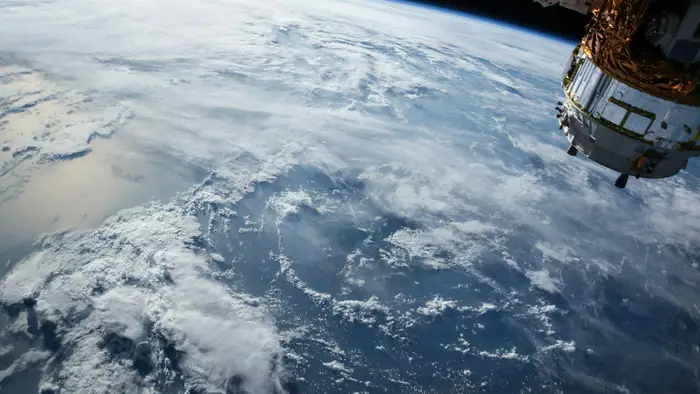
Earth seen from orbit. The diamonds mined today crystallized 150 to 200 kilometres beneath the crust, in a part of the planet no mine or drill has ever reached.
The Calendar Problem
Even if you could somehow bury coal to the right depth — you cannot — the timeline still makes the myth impossible. This is the argument geologists reach for first, because it is devastatingly simple: most diamonds are older than coal itself.
Natural diamonds are routinely dated at over a billion years old, with many estimates running to two or three billion. The oldest precisely dated diamonds known come from sulphide inclusions in stones from Canada’s Ekati mine, which clock in at about 3.52 billion years old — roughly three-quarters of the age of the Earth, older than the oxygen in the atmosphere. Diamonds, in other words, were crystallizing while the planet was still young, in eras when the only life on Earth was microbial.
Coal, by contrast, is a much younger phenomenon. It forms from the compressed remains of land plants — trees, ferns, and other vegetation — and the earliest land plants did not appear until roughly 400 million years ago. Coal formation is generally traced to the period 300 to 400 million years ago and later. Do the arithmetic: the diamonds were already a billion or more years old before the first coal swamp existed. A diamond cannot be made from a plant that would not exist for a billion years after the diamond crystallized.
This single fact collapses the myth on its own. Every other argument — the depth, the pressure, the impurities — is corroboration. The calendar is the killing blow.
How We Know: Dating Diamonds That Can’t Be Dated Directly
You might wonder how scientists can possibly date a diamond, given that diamond is pure carbon and the standard radiocarbon dating method only reaches back tens of thousands of years. The answer is elegant: geologists date the tiny mineral inclusions trapped inside the diamond as it grew. When a diamond crystallizes deep in the mantle, it occasionally swallows microscopic grains of the surrounding minerals — sulphides, garnets, silicates — sealing them in a pressure-proof vault. Those inclusions can be dated with radiometric methods that work over billions of years, giving the diamond a minimum age: the diamond must be at least as old as the minerals locked within it.
The 3.52-billion-year figure from the Ekati mine came from exactly this technique, applied to sulphide inclusions in Canadian stones. Similar work on diamonds from mines on several continents has produced a consistent picture: diamond formation has happened in distinct episodes across Earth’s history, most of it very long ago, and some of it possibly still happening in the deep mantle today. None of it has anything to do with coal seams.

An astronaut drifting above Earth’s horizon. No one has ever visited the mantle depths where diamonds form; scientists read their history from mineral inclusions trapped inside the gems.
The Explosive Elevator to the Surface
If diamonds form 150 kilometres down and mines operate near the surface, something has to bridge the gap. That something is one of the most dramatic phenomena in geology: the kimberlite eruption.
Kimberlite is a type of deep-source magma that occasionally blasts upward from the mantle at extraordinary speed, carrying diamonds and other mantle rock along for the ride. Named after Kimberley, the diamond-rich region of South Africa where these rocks were first identified, kimberlite magmas are thought to ascend through the lithosphere at roughly 4 to 20 metres per second — fast enough that the entire journey from the deep mantle to the surface may take anywhere from under ten hours to about two days. That speed matters: if the magma rose slowly, the diamonds would revert to graphite as pressure dropped. Only a violent, rapid elevator preserves them.
When the magma cools near the surface, it forms narrow, pipe-shaped volcanic structures — kimberlite and lamproite pipes — that serve as signposts for diamond hunters. All of the world’s kimberlite diamond deposits sit within ancient continental shields, the cratons of Africa, Australia, Russia, South America, and North America. Kimberlite volcanism is extremely rare; geologists estimate the most recent eruption took place roughly 10,000 years ago. The diamond mines of today are excavations of ancient eruptions, dug into pipes that have been quiet for tens of millions of years.
Coal plays no role in this story at any stage. The magma starts in the mantle, the carbon was already there, and the eruption merely delivers the finished product. Describing this as “coal turning into diamond” would be like saying a pizza delivery driver baked the pizza.
What Coal Actually Is
The myth also depends on a fuzzy picture of coal, so it is worth getting coal right. Coal is a sedimentary rock formed from the decayed remains of plants — mostly the lush vegetation of ancient swamps — buried under layers of sediment near the Earth’s surface. The pressure that transforms plant debris into coal comes from the weight of those overlying layers, not from the crushing forces of the deep Earth. Coal seams are typically buried only a few kilometres deep at most.
That shallow, gentle history leaves coal chemically impure. Beyond carbon, coal contains hydrogen, oxygen, nitrogen, sulfur, and various mineral ash — a cocktail of contaminants that makes the idea of a pure carbon crystal lattice forming from it chemically implausible. Turning coal into diamond would first require purifying away all of those elements and then rearranging the carbon atoms into a perfect tetrahedral lattice, under pressures tens of thousands of times greater than anything a coal seam ever experiences. Nature simply never does this. There is no known geological pathway that takes a coal bed and delivers it to the diamond-forming depths of the mantle, and no known diamond deposit whose carbon can be traced to coal.
It is worth adding a nuance that honest geology demands. Some diamonds do contain carbon with an “organic” isotopic signature, suggesting that at least some of the carbon in the mantle was once part of living things, dragged down by subducting oceanic plates over immense spans of time. But that recycled carbon is carbonate rock and marine sediment from the deep ocean — not coal. And even the most generous reading of the evidence does not produce a coal-to-diamond pipeline. The claim under examination is that diamonds are formed from coal. They are not.
Could We Make Diamonds From Coal in a Lab?
This is where a careful reader might raise a hand: scientists do manufacture diamonds in laboratories, using high-pressure, high-temperature (HPHT) presses that mimic mantle conditions. Could coal be the feedstock?
In principle, diamond synthesis needs a carbon source and extreme conditions, and in practice the industry uses purified graphite or carbon-rich gases like methane — never coal. Coal’s impurities make it a terrible starting material; no manufacturer would choose a contaminated feedstock when pure graphite is cheap and available. So even in the lab, where humans control every variable, the answer is no: nobody makes diamonds from coal, because nobody would want to. The myth fails in the factory as well as in the Earth.
Why the Myth Refuses to Die
If the science is this settled, why does the claim keep circulating? Part of the answer is poetry. Coal-to-diamond is a redemption story: pressure makes something dirty into something precious. It flatters our intuition that suffering and effort produce value, which is why motivational posters love it. The jewelry industry has little incentive to correct a story that makes its product sound like the triumphant end of an epic journey.
Part of the answer is pedagogy gone wrong. The coal-to-diamond pipeline is a tempting simplification for a teacher trying to explain the carbon cycle or metamorphism in forty-five minutes. Once lodged in a textbook or a classroom aside, it replicates itself down the generations — each student becoming a teacher who passes it on.
And part of the answer is the modern internet, where the claim survives in listicles, quiz sites, and social media posts that copy from one another without ever consulting a geologist. Search engines reward confident repetition, not accuracy, and a myth stated in a thousand places looks like consensus.

A smartphone displaying a search engine — the channel through which the coal-to-diamond myth now replicates itself, copied from site to site without a geologist in sight.
The Diamond Trade’s Convenient Story
There is one more reason the myth has legs, and it is measured in dollars. The diamond industry has spent more than a century building a mythology of rarity, romance, and transformation around its product — most famously the “a diamond is forever” campaign that turned a mined mineral into a mandatory symbol of commitment. A story in which humble coal becomes a dazzling gem through pressure and time fits that marketing like a setting fits a stone. It is not that jewelers invented the myth; it is that they had no reason to kill it.
The economics are real enough without the fable. Diamonds are genuinely rare in the sizes and clarities the jewelry market wants, genuinely difficult to extract from kimberlite pipes hundreds of metres deep, and genuinely useful in industry — drill bits, cutting tools, and heat spreaders in electronics all rely on diamond’s hardness and thermal conductivity. The stone needs no fairy tale. But fairy tales sell, and this one sells particularly well because it contains a grain of truth: both coal and diamond are carbon, and pressure really is part of the diamond’s story. It is just the wrong pressure, in the wrong place, a billion years before coal existed.

Stacks of dollar bills. The diamond trade has spent a century building a mythology of transformation around its product — and a coal-to-diamond fairy tale was never going to hurt sales.
The Verdict
Verdict: False. Diamonds are not formed from coal, and the evidence against the claim is about as strong as geological evidence gets:
- Depth: Diamonds crystallize 150 to 200 kilometres down in the Earth’s mantle, under 45,000 to 60,000 times atmospheric pressure and 900 to 1,300 degrees Celsius. Coal forms within a few kilometres of the surface.
- Age: Most diamonds are over a billion years old; the oldest precisely dated stones are about 3.52 billion years old. Land plants — the raw material of coal — appeared only about 400 million years ago, and coal formation dates to 300 to 400 million years ago. The diamonds predate coal by a billion years or more.
- Chemistry: Diamond is roughly 99.95 percent pure carbon in a perfect crystal lattice. Coal is an impure sedimentary rock full of hydrogen, oxygen, nitrogen, and sulfur.
- Carbon source: The carbon in natural diamonds comes from deep-Earth materials — primordial mantle carbon and subducted carbonate rocks — not from coal seams. No known diamond deposit traces its carbon to coal.
- Delivery: Diamonds reach the surface in kimberlite eruptions, violent mantle-to-surface elevators. Coal is not involved at any stage.
The myth survives on a true but trivial observation — both substances contain carbon — inflated by pop culture, lazy pedagogy, and an industry that finds the story useful. It is, as The Naked Scientists concluded, fictional. The real story is far more spectacular anyway: gems older than complex life, forged in the dark roots of continents and fired to the surface by eruptions that crossed a hundred and fifty kilometres of solid rock in a matter of hours. Coal’s redemption arc was never needed. The diamond had a better origin story all along — it was just buried, quite literally, too deep for anyone to see.