No, Bulls Are Not Enraged by the Color Red — What Science Says About the Bullfighting Myth
Few images in popular culture are as firmly glued together as the raging bull and the red cape. In cartoons, the bull paws the ground, snorts smoke, and locks its eyes on a scrap of crimson cloth. In the actual bullring, the matador’s muleta — a small red cape stretched over a wooden dowel — flicks through the air, and a half-ton animal thunders after it. It all looks so convincing that the phrase “a red rag to a bull” has become shorthand in the English language for something guaranteed to provoke outrage. Spanish speakers have their own version: ponerle a alguien un trapo rojo, to put a red rag in front of someone, meaning to deliberately rile them up.
But here is the problem with that vivid picture: the bull, scientifically speaking, can barely see the color red at all. What it can see extremely well is movement. And that single physiological fact unravels a myth that has survived for centuries — a myth that one famous television experiment put to the test in front of millions of viewers, and that veterinary ophthalmologists can explain with the anatomy of a retina. The bull is not seeing red. It never was.
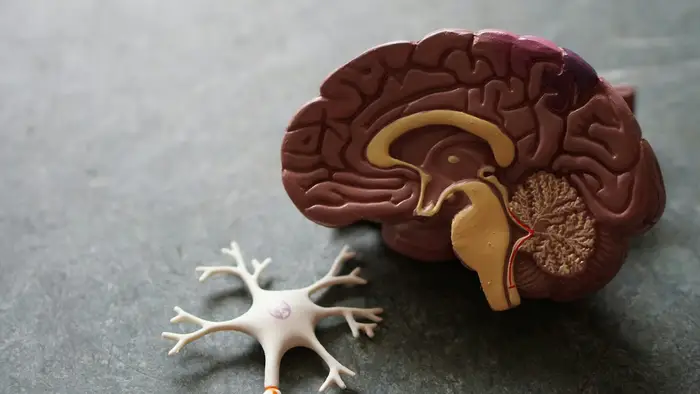
Anatomical brain model (illustration): color perception begins in the retina, and a bull’s retina is built very differently from a human’s.
The Claim
The claim under examination is simple and widely believed: bulls become enraged specifically by the color red, which is why matadors wave red capes in the bullring. The story is so familiar that most people never question it. It shows up in children’s books, advertising, animated films, and everyday speech. The supposed mechanism feels intuitive, almost scientific-sounding: red is the color of blood and danger, so naturally a hot-tempered animal would react to it.
The claim also carries a corollary that many people believe without realizing it: that bulls, and cattle generally, see colors the way humans do, and therefore the bull in the arena is responding to the same screaming crimson the audience sees. Both halves of this claim — that bulls react to red, and that they even perceive red as red — are the subject of this fact-check. They are both wrong, and the evidence has been in place for decades.
Before going further, one point of honesty is worth making. This is not a claim anyone invented last week, and it is not a fringe internet rumor. It is a centuries-old cultural assumption wrapped around one of the world’s oldest continuous spectacles. Disproving it requires taking apart the biology of bovine eyes, the results of a well-known experiment, and the actual history of why that cape is red in the first place. Each piece of evidence, taken on its own, is enough to make the myth wobble. Together, they knock it flat.
Seeing Through a Bull’s Eyes
To understand what a bull perceives, it helps to start with how color vision works in the first place. In the retina at the back of the eye sit specialized cells called cones, each tuned to respond to a particular slice of the light spectrum. Humans are trichromats: we carry three cone types, sensitive to short, medium, and long wavelengths of light — roughly blue, green, and red — and our brains blend their signals into the full rainbow we experience.
Cattle, bulls included, are dichromats. Their retinas contain only two types of cone cells. The definitive measurement comes from work by Gerald Jacobs and colleagues, who used a technique called electroretinogram (ERG) flicker photometry to measure the spectral properties of cones in cattle (Bos taurus), as well as goats and sheep. In each species they identified exactly two cone mechanisms: one short-wavelength mechanism with peak sensitivity around 444 to 455 nanometers — the blue end of the spectrum — and one medium-to-long-wavelength mechanism with peak sensitivity tightly clumped around 552 to 555 nanometers, in the yellow-green range.
That missing third cone type is the whole story. The long-wavelength receptors humans use to distinguish reds simply do not exist in the bovine eye. Cattle can discriminate blues and yellows, and they can see grays, but reds, oranges, pinks, and purples collapse into a muted, washed-out range. To a bull, the matador’s scarlet muleta does not blaze. It reads as a dull brownish-gray or a dim yellowish shade — about as provocative as a dishrag. Veterinary researchers describe bovine vision as essentially red-green color blind, comparable to the human condition called protanopia, in which the red-sensitive cones are absent.
This is not a new or contested finding. Behavioral studies, such as the work by Phillips and Lomas published in the Journal of Dairy Science in 2001, have tested cattle’s ability to discriminate between colors in controlled conditions and confirmed the pattern: cattle handle blue, green, and yellow distinctions but struggle with reds. It is also exactly what evolutionary biology would predict. Most mammals — dogs, cats, horses, deer — are dichromats. Trichromatic color vision, with three cone types, is the oddity, found in humans, other primates, and a handful of other species. The bull’s eyes are normal mammal eyes. Ours are the unusual ones.
There is more to bovine vision than the color palette, and the rest of it helps explain the bull’s behavior in the ring. Cattle eyes are mounted on the sides of the head rather than facing forward, giving them a panoramic visual field estimated at roughly 330 to 360 degrees — nearly all the way around. The tradeoff is visual acuity: their vision is relatively blurry by human standards, estimated in the range of 20/60 to 20/100, and they see detail best at distances of one to two meters. Beyond that, fine detail falls off quickly. What they do have, crucially, is acute sensitivity to motion. A prey-derived herbivore with poor detail vision and nearly panoramic coverage is an animal built to detect movement first and ask questions later. When a large object suddenly flaps and sweeps through that wide field of view, the bull’s brain registers threat long before it registers — or fails to register — color.
So the physiological verdict is unambiguous: a bull cannot be “seeing red” in the way the myth requires, because the visual machinery needed to see red is absent from its eyes. The claim fails at the retina. But physiology alone does not settle the question of behavior. An animal might still, in theory, associate a particular shade of gray with danger. For the behavioral evidence, the myth needed a head-on test — and it got one.

A stethoscope (illustration): veterinary science has measured bovine color vision directly, from retinal photopigments to behavioral tests.
The Experiment That Went Into the Ring
In 2007, the television show MythBusters devoted a segment to this exact question, in an episode centered on bull-related myths that included the famous “bull in a china shop” test. The segment, titled “Red Rag to a Bull,” put co-hosts Grant Imahara, Tory Belleci, and Kari Byron into a bullring with a live bull to test the claim empirically.
Their approach was straightforward and well-designed for television. They set out dummies dressed in three different colors — red, white, and blue — and released the bull to see which one it would single out. Then they escalated: a live person wearing red stood perfectly still in the arena while two others, dressed in white and blue, moved around it. The bull’s response was decisive. It charged the dummies regardless of color, and in the live test it ignored the motionless figure in red and went after the moving ones in white and blue. When the stationary red-clad person began to move, the bull’s attention shifted immediately. The variable that predicted the charge was never the color of the cloth. It was always the motion.
The show’s verdict, in its own language, was that the myth was busted: bulls are effectively colorblind to red, and their aggressive behavior is triggered by movement, not by hue. The segment has since become one of the most widely cited popular-science demonstrations of the point, and other write-ups of similar arena tests have reported the same pattern — bulls charge a vigorously flapped cloth whether it is red, blue, white, or black, and they show no interest in a stationary red object that offers nothing for their motion-tuned vision to lock onto.
A note of scientific caution is warranted here. MythBusters was an entertainment program, not a peer-reviewed laboratory, and a single televised trial with one bull in an arena is not the same as a controlled behavioral study. The show’s methods were rough by research standards: the sample size was tiny, the setting was noisy, and the bull in question was a fighting-bull-breed animal already selected and conditioned for aggression. No one should treat the segment as a formal experiment. But that is not its role in this story. Its role is as a vivid demonstration of a result that formal science — the retinal physiology, the ERG measurements, the color-discrimination studies — independently supports. When the anatomy says the animal cannot see red and the arena test shows the animal ignoring a motionless red target while charging moving ones of every other color, the two lines of evidence point the same way.
There is also a simpler everyday confirmation available to anyone who works with cattle. Ranchers, dairy workers, and rodeo hands do not wear special non-red clothing around bulls, because in practice bulls react to how a person behaves — sudden movements, approaching head-on, invading their space — not to the color of a shirt. The entire cattle-handling world operates on the assumption that movement, posture, and positioning are what matter. If red fabric truly enraged bulls, every farm supply store in cattle country would have posted a warning decades ago.
What Really Sets a Bull Off
If color is not the trigger, what is? The answer is a combination of biology, breeding, and circumstance, and it is more interesting than the myth.
First, bulls are territorial and defensive animals. An intact breeding male is wired to protect his space, his herd, and his status, and sudden or aggressive movement — especially something large and flapping sweeping toward him — reads as a threat or a challenge. The charge is a defensive response, the fight half of the fight-or-flight response, triggered when a perceived danger invades the animal’s space and escape does not look like the better option. This is why handling experts emphasize smooth, predictable movement around cattle: jerky, flapping motion is precisely the stimulus their visual systems are tuned to detect and react to.
Second, the bulls in the ring are not random pasture animals. Spanish-style bullfighting uses the toro de lidia, the Iberian fighting bull, a breed shaped by centuries of selective breeding for aggression, stamina, and the willingness to charge. These animals are raised to respond explosively to provocation, and they are worked up by the entire structure of the event long before the muleta appears: the noise of the crowd, the confinement, the horses, the earlier stages of the fight. By the time the matador makes his passes, the bull is in a state of heightened arousal in which any large moving object will do. The red cloth is the instrument, not the cause.
Third, contrast and novelty matter more than hue. A cape snapping open against the pale sand of the arena is a high-contrast visual event even in a dichromat’s muted palette — a sudden dark shape blooming and collapsing in the bull’s visual field. The matador’s body language amplifies it: the planted feet, the squared shoulders, the deliberate extension of the cloth toward the animal. Every element of the performance is choreographed to hold the bull’s attention through motion, because motion is the channel the bull is listening on.
Put together, the real provocation sequence runs like this: a selectively bred aggressive animal, stressed and aroused by the arena environment, detects a large object moving sharply in its panoramic field of vision, interprets the motion as a threat, and charges the moving thing. Color never enters the equation, because the animal’s eyes never admitted it.
Why the Cape Is Red, Then
This is the question the myth’s defenders always circle back to: if bulls cannot see red, why has the matador’s cape been red for as long as anyone can remember? The answer is that the cape is red for the audience, not for the bull — and the reasons are practical, historical, and theatrical.
The small red cape used in the final stage of the bullfight is called the muleta, and it appears in the tercio de muerte, the “third of death,” in which the matador works the bull through a series of passes before the kill. By that point in the fight, the bull has been wounded by the lances of the picadores and the banderillas placed in its shoulders. Blood is part of the spectacle, and red fabric is, straightforwardly, the color on which bloodstains show least. As encyclopedia accounts of Spanish-style bullfighting put it, the red color of the cape is a matter of tradition, because bulls are color blind; the color’s practical purpose is to mask blood stains, keeping the spectacle visually palatable for the spectators. Some accounts add a second practical motive: the dark red cloth also helps conceal the sword the matador holds alongside it during the passes.
The choice is also a matter of sheer theatricality. Red is the color of passion, danger, and drama in the visual language of the cultures that built the bullfight, and the crimson muleta against the sand, framed by the matador’s ornate traje de luces — the “suit of lights” — is one of the most recognizable stage pictures in the world. The tradition hardened over time until the color became inseparable from the ritual, but its roots are in stagecraft and stain-hiding, not animal psychology.
It is worth noting that early bullfighting did not even standardize on red. Historical accounts describe capes of various colors in earlier eras, and the association of red with the ring consolidated gradually — one widely repeated account traces the dominance of red to the eighteenth century, when the practical advantage of hiding bloodstains made crimson the matador’s working color and it simply never changed. Whatever the precise timeline, the direction of causation is clear: the red cape did not evolve to enrage the bull; the story that it enrages the bull evolved to explain the red cape. The myth is a post-hoc rationalization of a costume choice, not a report of an observed phenomenon.
That reversal — costume first, explanation later — is how a great many folk myths are born. A striking visual needs a story, and “the bull hates red” is a better story than “the bull can’t see red and the cape is crimson so the audience doesn’t have to look at blood.” The less flattering truth lost out to the more dramatic one, as it usually does.

A phone showing a search screen (illustration): the red-cape myth now spreads mostly through screens, long after the science settled it.
A Myth With a Long Memory
The persistence of the red-cape myth is itself worth examining, because it shows how an idea can outlive its evidence by centuries. The idiom did most of the work. Once “a red rag to a bull” entered the language as a figure of speech, it stopped being a claim about animals and became a piece of folk wisdom — something everybody knows, which is the hardest kind of belief to dislodge. Children absorb it from cartoons in which a bull’s eyes literally glow at the sight of red. Tourists absorb it in the arena, watching a half-ton animal chase crimson cloth and drawing the obvious, wrong conclusion. The spectacle is the perfect misdirection: the one thing the audience and the bull are both staring at is the one thing they are seeing completely differently.
Language, spectacle, and intuition formed a closed loop. The phrase confirmed the picture, the picture confirmed the phrase, and the actual retina of the actual bull — with its two cone types and its 552-nanometer ceiling — never got a vote. This is a pattern fact-checkers see again and again: a vivid, concrete image defeats an abstract physiological fact in the contest for human belief, because the image is available to everyone and the fact is available to specialists.
The myth also benefited from a kernel of something true, which is the most durable kind of falsehood. It is absolutely true that bulls in the ring charge at the red cape. An observer who knows nothing about bovine vision sees cause and effect: red cape waved, bull charges. The error is not in the observation but in the attribution — mistaking correlation for mechanism. Science’s contribution was not to deny that the bull charges, but to separate the variables: hold the color constant and vary the motion, and the behavior follows the motion; hold the motion constant and vary the color, and nothing changes. That is the difference between watching a bullfight and understanding one.
The Verdict
The claim that bulls are enraged by the color red is False.
The evidence converges from three independent directions. First, the anatomy: cattle are dichromats whose retinas carry only two cone types, with peak sensitivities in the blue (around 444–455 nm) and yellow-green (around 552–555 nm) ranges, as measured by Jacobs, Deegan, and Neitz. They lack the long-wavelength receptors required to perceive red, making them effectively red-green color blind. A bull cannot be provoked by a color it cannot see.
Second, the behavioral evidence: arena demonstrations, most famously the “Red Rag to a Bull” segment on MythBusters, show that bulls charge moving cloth of any color — red, white, or blue — and ignore a stationary red target. The trigger is movement, not hue. The working knowledge of everyone who handles cattle for a living says the same thing.
Third, the history: the matador’s red muleta is red for the audience’s benefit — to mask bloodstains during the tercio de muerte, and to serve a theatrical tradition — not because the color agitates the animal. Earlier capes were not even standardized on red.
What actually provokes the bull is the flapping motion of the cape, amplified by territorial and defensive instincts, centuries of selective breeding for aggression, and the stress of the arena itself. The redness of the cape is stagecraft. The charge is biology. And the myth, for all its color, was never more than a story the audience told itself about a show it was already watching.
So the next time someone reaches for the phrase “a red rag to a bull,” the accurate version goes something like this: wave anything large and flappy at a stressed, selectively bred, motion-sensitive territorial animal, and it will charge. The color was never the point. It was always the dance.